What is a good market breadth indicator?
Popular ones are advance-decline numbers, the percentage of stocks above key moving averages, and new highs versus new lows. Using a few together gives a clearer picture.
Swing trading glossary
Market breadth measures how many stocks are taking part in a move, such as how many are rising or are above their averages.
Market breadth looks beneath the index. Instead of asking whether the Nifty is up, it asks how many stocks are actually doing well. Common measures include advancing versus declining stocks, the share of stocks above their 20 or 50 EMA, and the number of new 52-week highs versus lows.
Breadth matters because an index can be held up by a handful of large stocks while most others are falling. When breadth is strong, many stocks are trending and swing setups tend to work better. When breadth is weak, even good-looking charts fail more often.
Swing traders use breadth as part of reading the market first. Rising breadth after a correction can show a new uptrend forming before the index makes it obvious. Falling breadth while the index still rises is an early warning that the move is narrowing.
Breadth is not a timing tool on its own. It works best combined with the index trend and with industry strength, as one input in a top-down routine. A simple routine is to check a couple of breadth readings after the close each day and note whether they are improving or weakening. Over a few weeks, that habit makes it much easier to see when the market environment is changing.
On a given day, 1,400 stocks rise and 700 fall, and the share of stocks above their 20 EMA moves up from 45% to 60%. Breadth is improving, even if the index itself only moved slightly.
Popular ones are advance-decline numbers, the percentage of stocks above key moving averages, and new highs versus new lows. Using a few together gives a clearer picture.
Most stocks follow the broad market. Strong breadth means more stocks are trending, which usually makes setups more reliable.
Related terms
N.E.X.T reads the market, ranks 65+ industries and runs focused momentum scans across 2,100+ NSE stocks every day.
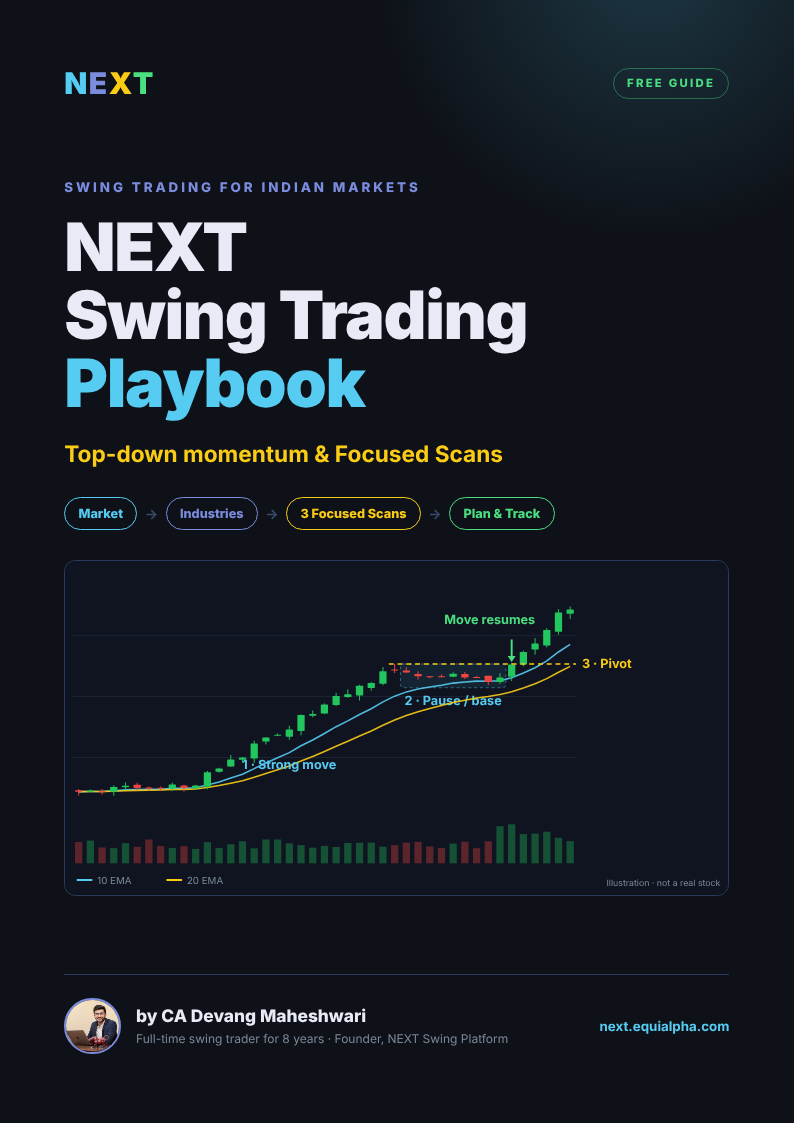
Get every guide in one PDF
The free NEXT Swing Trading Playbook — 11 chapters, charts and printable checklists.

Written by CA Devang Maheshwari — full-time swing trader for 8 years, founder of Equialpha and builder of N.E.X.T, the swing trading platform for Indian markets. About Devang