Method

The Top-Down Approach to Swing Trading

Most beginners start with a stock they like and work backwards. The top-down approach flips that: start with the market, then the industry, and only then the individual chart.

By CA Devang Maheshwari · Updated 2 November 2026

Quick answer

The top-down approach to swing trading means checking conditions in order: first market direction (is the index in an uptrend?), then which industries are strong, then which stocks in those industries show momentum, and finally whether a stock has a defined setup with a pivot and stop-loss. The order matters because a good chart in a weak market or weak industry fails far more often.

Top-down, one layer at a time

Each layer filters the next.

Step 1
Market

Uptrend, downtrend or trying to turn?

Step 2
Industries

Which of 65+ groups have momentum?

Step 3
Stocks

Leaders inside the strong industries

Step 4
Setup

A defined pivot and stop-loss

By the time you reach a chart, the odds are tilted in your favour — or you've decided to wait.

What is the top-down approach?

Top-down means starting with the big picture and narrowing down. You ask whether the market is supportive, then where strength is concentrated, and only then which specific stock to study.

It's like a captain reading the pitch and conditions before choosing the batting order. The best batter still struggles on a minefield; the right conditions make a good plan work.

Key idea

Bottom-up asks “is this a good chart?”. Top-down asks “is this a good chart, in a good industry, in a good market?”.

Why the order matters

Most stocks follow the market

When the index falls, even strong charts struggle. Breakouts fail more often in a downtrend.

Industries move in groups

Buyers usually rotate into whole industries, not single stocks. Strong groups give their members a tailwind.

Less noise

Filtering by market and industry first shrinks 2,100+ stocks into a short, focused list.

Better sizing decisions

Market direction tells you how much risk to take, not just what to buy.

For a deeper look at the industry layer, read why industry momentum leads stocks.

Step 1: read market direction

Market direction is judged on the index using price and the 10 and 20 EMAs on the daily chart.

StateWhat it looks likeHow to act
UptrendPrice above rising 10 & 20 EMAs; 10 EMA above 20 EMANormal size; setups have a tailwind
Uptrend tryIndex crosses above the 10 EMA but stays below the 20 EMASmall size; watch whether breakouts follow through
DowntrendPrice below falling 10 & 20 EMAs; 10 EMA below 20 EMAFew or no trades; protect capital

In weak or uncertain markets

Lower size and risk, take fewer trades, book profits faster, watch whether breakouts follow through, and increase exposure gradually. Protect capital before chasing opportunity.

Steps 2–4: industries, stocks and setups

  1. Find strong industries — Look for groups where many stocks are trending and showing momentum, not a single outlier.
  2. Pick the leaders — Within those industries, focus on stocks with strong trends and relative strength. See RS rating explained.
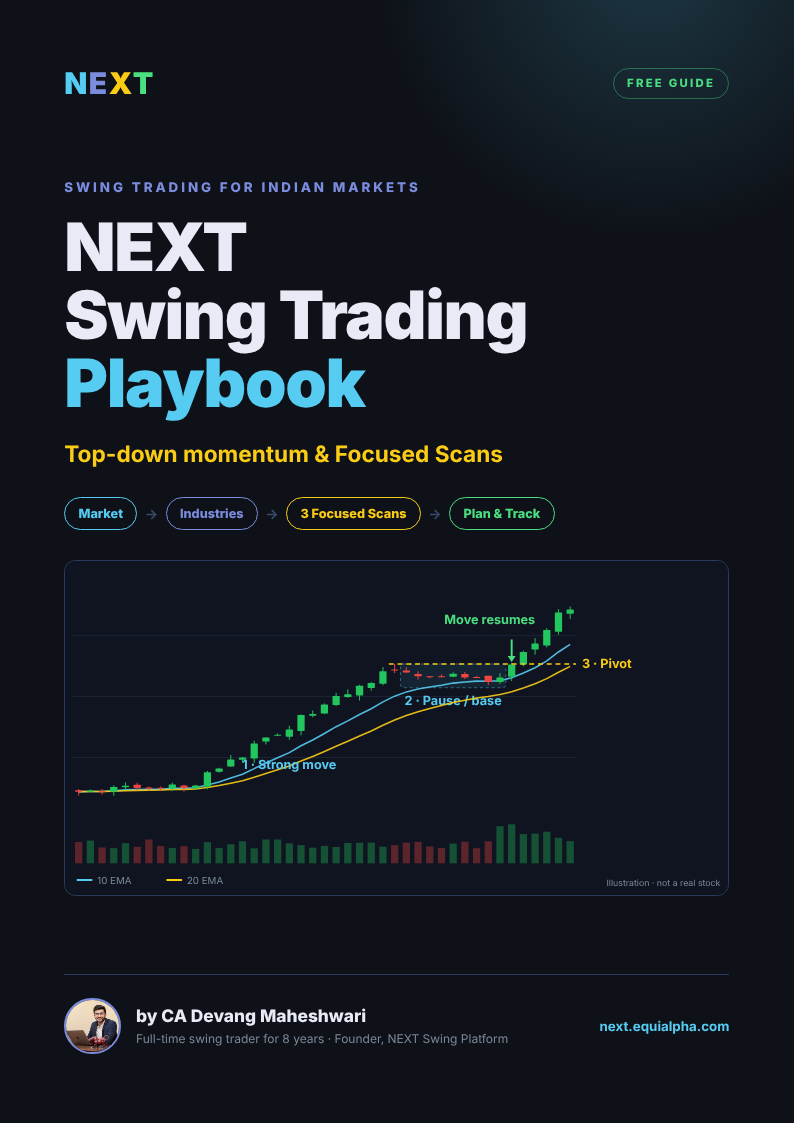
  3. Wait for a setup — A defined structure — a strong move, a pause and a pivot — tells you which price to watch. See swing trading setups.
  4. Plan risk — Mark the stop-loss and size the position. It's a candidate to evaluate, not an automatic entry.

How N.E.X.T applies it

N.E.X.T is a swing trading platform for Indian markets built around this exact order: top-down momentum, with focused scans.

  1. Market: market direction is shown first, so you know how active to be.
  2. Industries: 65+ industries are rated with N.E.X.T Momentum, a multi-factor industry momentum verdict, plus a Leading Industries view.
  3. Stocks: 2,100+ NSE stocks are rated on trend, industry strength, relative strength and scan activity. See how the N.E.X.T stock rating works.
  4. Setups: three focused scans — Follow Through Swing, 20 EMA Bases and IPO Bases — with pivots drawn in the Chart Terminal for your own review.

Tip

N.E.X.T doesn't recommend stocks or place orders. It organises the top-down process so you can review candidates and make your own decisions.

Frequently asked questions

What is the top-down approach in swing trading?

It's a method of checking market direction first, then strong industries, then individual stocks and finally a defined setup. Each layer filters the next, so you trade strong stocks in strong groups during supportive markets.

Why is market direction important for swing trading?

Most stocks follow the broader market. In a downtrend, breakouts fail more often, so market direction decides how much risk to take and how many trades to make.

How do I know if the market is in an uptrend?

A common rule is that the index trades above its rising 10 and 20 EMAs, with the 10 EMA above the 20 EMA. Trading below falling 10 and 20 EMAs points to a downtrend.

What is an “uptrend try”?

It's when the index crosses above its 10 EMA but stays below its 20 EMA — an attempt to turn up that isn't confirmed. Small size and close attention to follow-through make sense here.

What is the difference between top-down and bottom-up?

Bottom-up starts with an individual stock and judges it on its own. Top-down judges the market and industry first, so stock choices sit inside a supportive backdrop.

Does N.E.X.T use a top-down approach?

Yes. N.E.X.T shows market direction, rates 65+ industries with N.E.X.T Momentum, rates 2,100+ NSE stocks and runs three focused momentum scans — in that order.

See the top-down process in action

Watch the N.E.X.T walkthrough to see market direction, industry ratings and three focused momentum scans for NSE stocks on one platform.

Get every guide in one PDF

The free NEXT Swing Trading Playbook — 11 chapters, charts and printable checklists.

Keep reading

Browse all guides →
CA Devang Maheshwari

Written by CA Devang Maheshwari — full-time swing trader for 8 years, founder of Equialpha and builder of N.E.X.T, the swing trading platform for Indian markets. About Devang