How deep should a base be?
There is no single limit, but shallower bases are generally more constructive in strong markets. Deeper bases are more common after broad market corrections.
Swing trading glossary
Base depth is how far a stock falls from the top of its base to the lowest point inside it, measured as a percentage.
Base depth measures the size of the pullback inside a base. Take the high where the base started, find the lowest low within the base, and express the drop as a percentage. A base from ₹500 down to ₹425 is 15% deep.
Depth tells you how much damage the stock took while it rested. Shallow bases usually show that buyers stepped in quickly and supply was limited, which is common among strong leaders in a healthy market. Very deep bases mean more holders are sitting on losses, and many may sell as the price returns to old levels.
What counts as reasonable depth depends on the market and the stock. In a strong market, leaders often build shallower bases. After a broad market correction, deeper bases are normal because almost everything fell.
Depth is best read together with tightness. A base that gets shallower with each pullback, with tightening ranges towards the right side, is usually a healthier structure than one that stays wide and loose. Measuring depth also helps with planning. A deeper base usually means the logical stop below the base is further from the pivot, so the position size has to be smaller to keep the same rupee risk per trade.
A stock tops at ₹800 and pulls back to ₹680 before recovering. The base depth is (800 − 680) ÷ 800 = 15%.
There is no single limit, but shallower bases are generally more constructive in strong markets. Deeper bases are more common after broad market corrections.
They suggest buyers are supporting the stock and fewer holders are sitting on losses, which means less selling pressure near the pivot.
Related terms
N.E.X.T reads the market, ranks 65+ industries and runs focused momentum scans across 2,100+ NSE stocks every day.
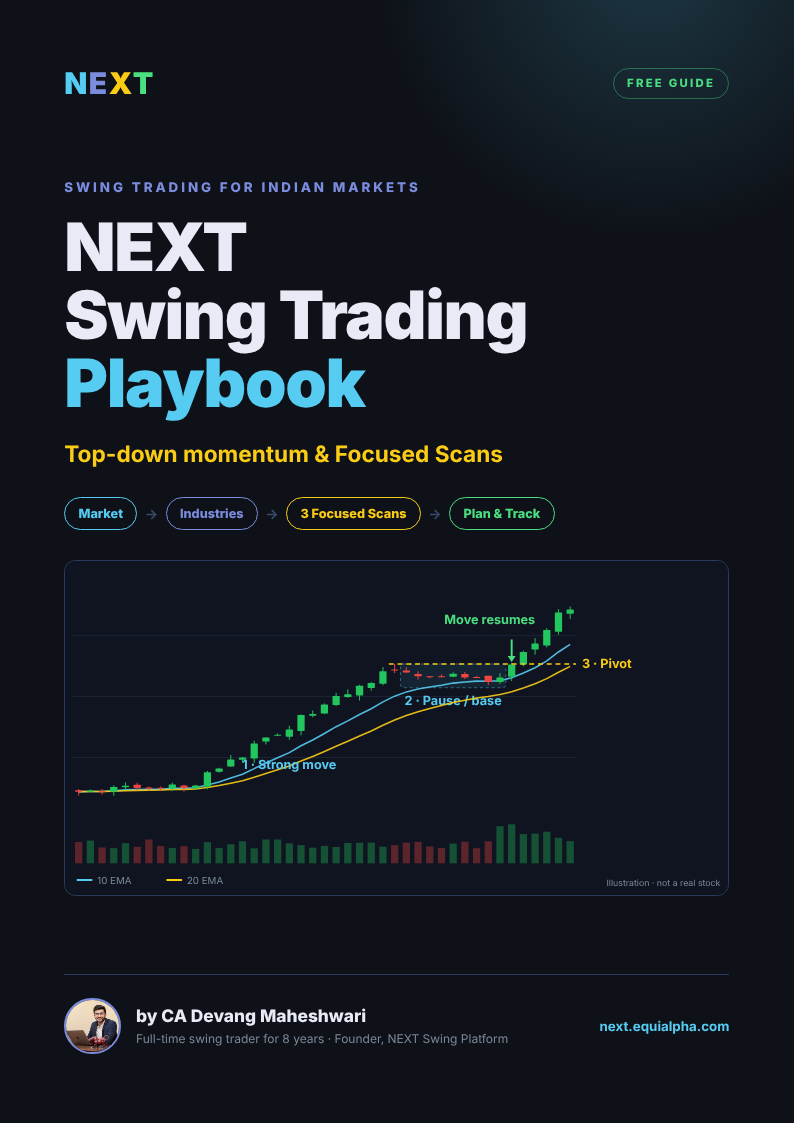
Get every guide in one PDF
The free NEXT Swing Trading Playbook — 11 chapters, charts and printable checklists.

Written by CA Devang Maheshwari — full-time swing trader for 8 years, founder of Equialpha and builder of N.E.X.T, the swing trading platform for Indian markets. About Devang