How deep is a normal pullback?
There is no fixed number, but healthy pullbacks in strong stocks are usually shallow and hold above rising short-term averages like the 10 or 20 EMA.
Swing trading glossary
A pullback is a short, temporary dip within an uptrend before price resumes its move higher.
Strong stocks do not move up in a straight line. After a burst higher, buyers take a breather and price drifts back for a few sessions. That dip, when the larger uptrend is still intact, is called a pullback.
Swing traders watch pullbacks because they can offer a lower-risk place to plan an entry. A healthy pullback is usually shallow, happens on lighter volume, and holds above a rising average such as the 10 EMA or 20 EMA. When price then turns back up and clears a nearby high, the trend may be resuming.
Not every dip is a pullback. If the drop is deep, comes on heavy volume, or breaks below important averages and prior lows, it may be the start of a correction or a change of trend. The difference matters, because buying a dip in a breaking trend is how small losses become large ones.
The key is to define in advance where the pullback idea is wrong, usually below the recent low or below the average it is respecting, and to size the position from that level.
A stock runs from ₹200 to ₹260, then dips to ₹244 over four quiet sessions while staying above its rising 20 EMA at ₹238. A trader plans an entry above the recent ₹252 high with a stop below ₹238, risking ₹14 per share.
There is no fixed number, but healthy pullbacks in strong stocks are usually shallow and hold above rising short-term averages like the 10 or 20 EMA.
It can offer a lower-risk entry only if the larger trend is intact and you have a clear level where the idea is wrong. A pullback is a pause, not a promise of more upside.
Related terms
N.E.X.T reads the market, ranks 65+ industries and runs focused momentum scans across 2,100+ NSE stocks every day.
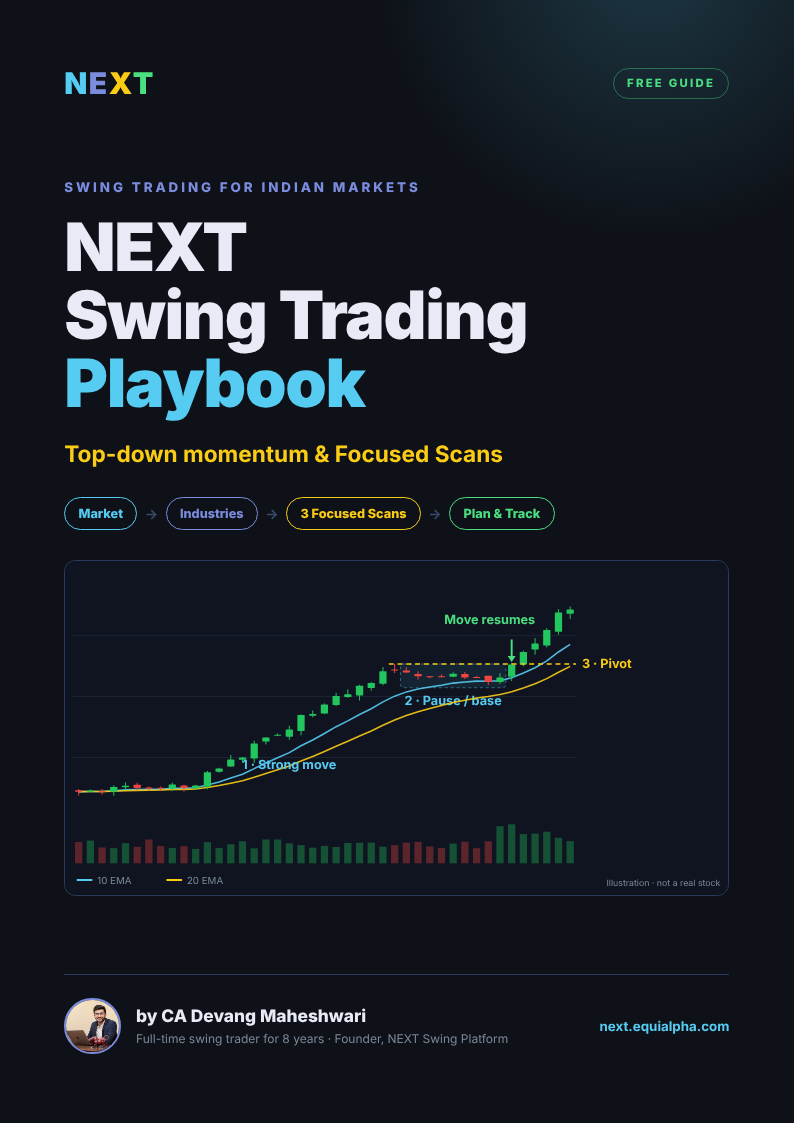
Get every guide in one PDF
The free NEXT Swing Trading Playbook — 11 chapters, charts and printable checklists.

Written by CA Devang Maheshwari — full-time swing trader for 8 years, founder of Equialpha and builder of N.E.X.T, the swing trading platform for Indian markets. About Devang