How many contractions does a VCP need?
Commonly two to four, with each pullback smaller than the one before. The tightening matters more than an exact count.
Swing trading glossary
A VCP (Volatility Contraction Pattern) is a base where each pullback gets smaller and volume dries up before a breakout.
The Volatility Contraction Pattern describes a base that tightens step by step. After an advance, the stock pulls back, rallies, pulls back again by a smaller amount, and repeats. The swings shrink from left to right, for example from a large first pullback to a medium one to a small one near the right side of the base.
This contraction shows supply being absorbed. Each round, fewer sellers are willing to sell at lower prices, so the dips get shallower. Volume usually dries up as the pattern tightens, and price often forms a few tight closes near the highs. The pivot is the top of the final, tightest contraction.
Traders look for VCPs in stocks that already show strength: in an uptrend, above rising averages, and ideally in a strong industry and a supportive market. The pattern itself is only part of the picture.
The appeal of a VCP is the tight final range. Because the last contraction is small, a stop-loss below it can be close to the entry, which keeps risk per share low for a given position size.
A stock pulls back 20% from ₹500, rallies, then pulls back 10%, then 5%, with the last contraction between ₹480 and ₹456. Volume shrinks through the pattern. A trader plans an entry above ₹480 with a stop below ₹456.
Commonly two to four, with each pullback smaller than the one before. The tightening matters more than an exact count.
At the top of the last and tightest contraction, on the right side of the base.
Related terms
N.E.X.T reads the market, ranks 65+ industries and runs focused momentum scans across 2,100+ NSE stocks every day.
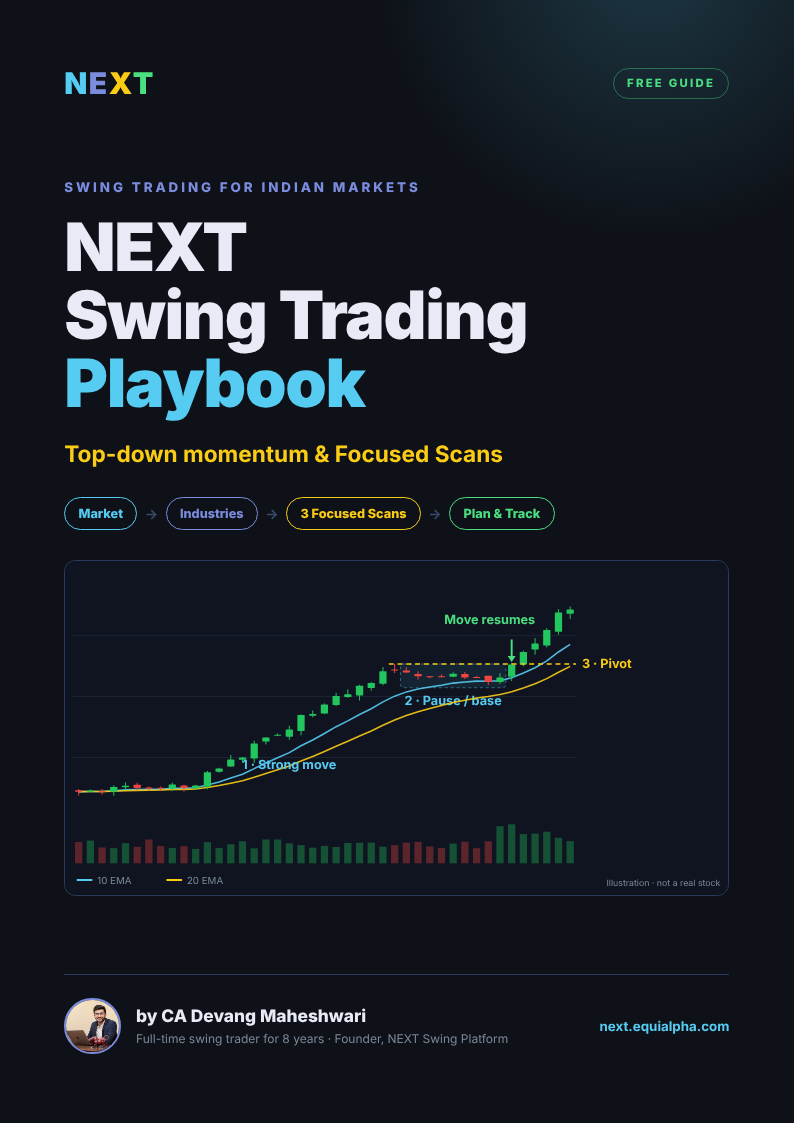
Get every guide in one PDF
The free NEXT Swing Trading Playbook — 11 chapters, charts and printable checklists.

Written by CA Devang Maheshwari — full-time swing trader for 8 years, founder of Equialpha and builder of N.E.X.T, the swing trading platform for Indian markets. About Devang