What is a false breakout?
A false breakout is when price clears the pivot but quickly falls back into the base, often on the same or the next day. A pre-decided stop-loss keeps the damage small.
Swing trading glossary
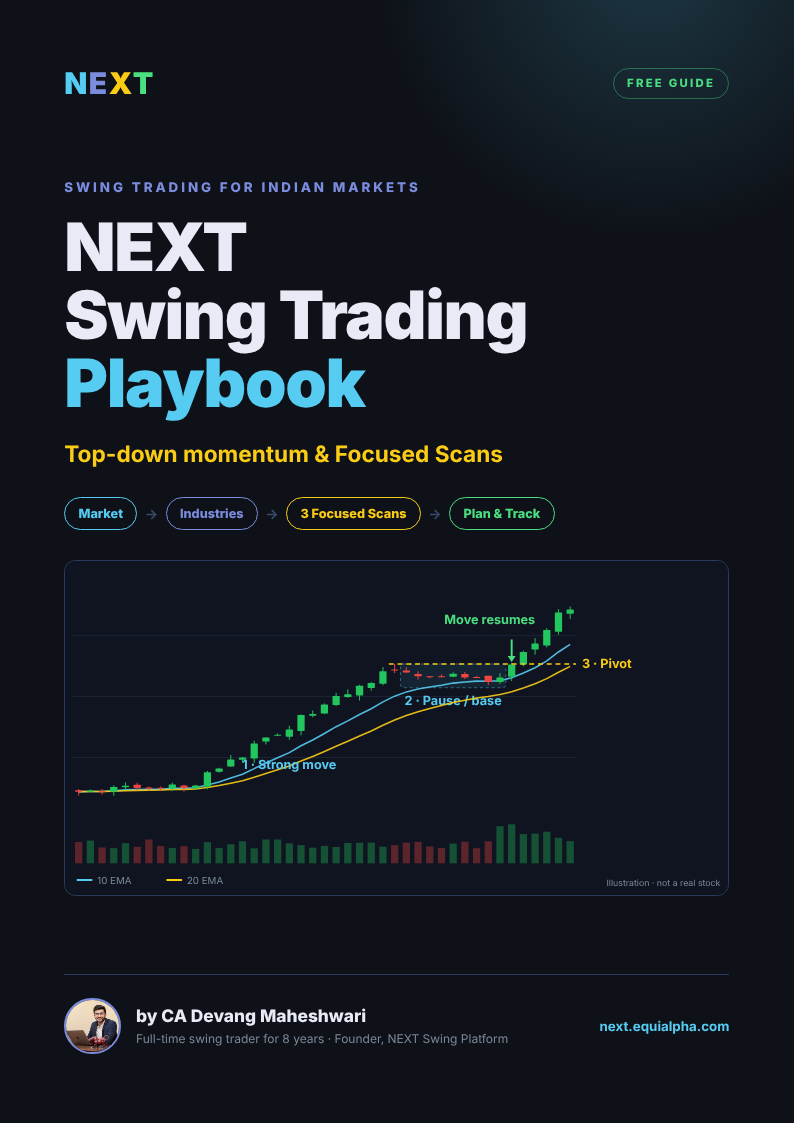
A breakout is price moving above the top of a base (the pivot), showing that buyers may have taken control again.
A breakout happens when a stock closes above the top of its base, the level called the pivot. Until then, sellers have capped the price at that level. Clearing it suggests demand is back.
On daily charts, swing traders usually care about the close, not just an intraday poke. A stock that trades above the pivot during the day but closes back inside the base has not really broken out. Volume also helps: a breakout on clearly higher volume than recent days shows real participation.
The breakout gives a defined entry with a defined risk. If you enter near the pivot, the stop can sit below the base or below its tightest area. That keeps the loss small if the move fails.
Breakouts fail often, especially when the overall market is weak. That is why many traders check market direction and industry strength first, and size positions so a failed breakout costs only a small, planned amount. Before acting on any breakout, it helps to ask three things: is the market helping, is the stock's industry strong, and is the base it is leaving tight and orderly? A yes to all three gives the breakout a much better chance than a breakout taken in isolation.
A stock bases between ₹480 and ₹500 for three weeks. One day it closes at ₹506 on about twice its usual volume. That close above ₹500 is the breakout; a stop might sit near ₹478, below the base.
A false breakout is when price clears the pivot but quickly falls back into the base, often on the same or the next day. A pre-decided stop-loss keeps the damage small.
That depends on your rules. Many swing traders act near the close or the next day once the close above the pivot is confirmed, and avoid entering if price is already far above the pivot.
Related terms
N.E.X.T reads the market, ranks 65+ industries and runs focused momentum scans across 2,100+ NSE stocks every day.
Get every guide in one PDF
The free NEXT Swing Trading Playbook — 11 chapters, charts and printable checklists.

Written by CA Devang Maheshwari — full-time swing trader for 8 years, founder of Equialpha and builder of N.E.X.T, the swing trading platform for Indian markets. About Devang