What does high volume on a breakout mean?
It suggests strong participation behind the move, which makes the breakout more credible than one on light volume. It is a supporting sign, not a certainty.
Swing trading glossary
Volume is the number of shares traded in a session; it shows how much participation is behind a price move.
Volume measures how many shares changed hands during a day. On a chart it usually appears as bars below the price. Price tells you what happened; volume tells you how many people took part in it.
Swing traders read volume alongside price. A breakout above a pivot on volume clearly above its recent average suggests real demand. A breakout on thin volume is more likely to fail. Inside a base, volume that dries up while price tightens often means sellers are running out.
Volume also helps judge pullbacks. A quiet pullback on lighter volume is usually a normal pause. A sharp drop on heavy volume, especially below key averages, shows serious selling and deserves respect.
In India it also helps to look at turnover, which is volume multiplied by price. A stock trading a large number of shares at a very low price may still have little rupee value changing hands, which affects how easily you can enter and exit. Comparing a day's volume with its recent average, such as the 50-day average, is more useful than looking at the raw number alone.
A stock's 50-day average volume is 2 lakh shares. On the day it clears its ₹300 pivot, 6 lakh shares trade, about three times the average. That expansion supports the breakout more than a move on 1.5 lakh shares would.
It suggests strong participation behind the move, which makes the breakout more credible than one on light volume. It is a supporting sign, not a certainty.
As price tightens and fewer holders want to sell, trading activity falls. Low volume inside a tight base often shows that supply is drying up.
Related terms
N.E.X.T reads the market, ranks 65+ industries and runs focused momentum scans across 2,100+ NSE stocks every day.
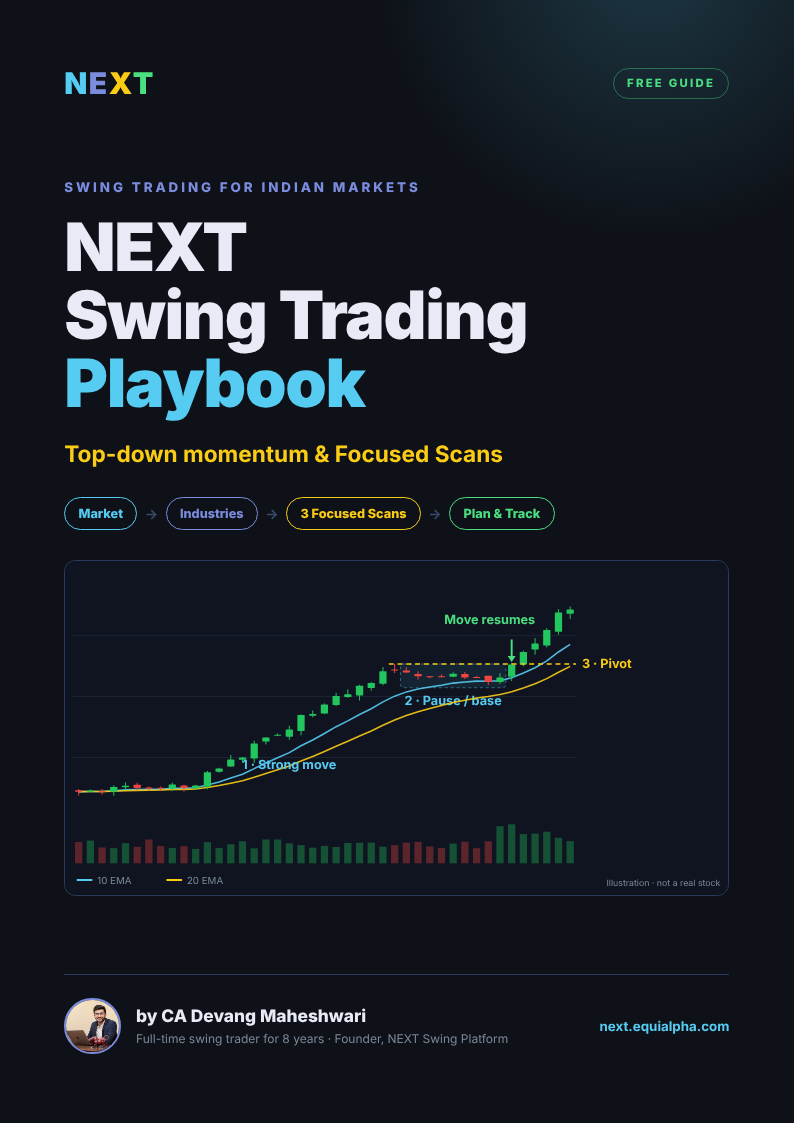
Get every guide in one PDF
The free NEXT Swing Trading Playbook — 11 chapters, charts and printable checklists.

Written by CA Devang Maheshwari — full-time swing trader for 8 years, founder of Equialpha and builder of N.E.X.T, the swing trading platform for Indian markets. About Devang