How do I know if I am chasing a stock?
If your entry is far above the pivot or the moving averages and a logical stop would be a long way below, you are likely chasing.
Swing trading glossary
Chasing means buying a stock after it has already moved far beyond its proper entry point, usually out of fear of missing out.
Chasing is buying a stock well after the move has started, far above the pivot or the moving averages, usually because it keeps rising and you don't want to miss out. The trade feels urgent, but the structure behind it is weak.
The problem is the stop. A logical stop sits below the base or a key average. If you buy far above that level, either the stop is too far away and the rupee risk is large, or you place an arbitrary tight stop that a normal pullback will hit.
Extended stocks also tend to pause or pull back. After a sharp run, early buyers often book profits, and the price can drift back towards its averages. Chasers who bought near the top are the ones forced out during that shakeout.
The alternative is patience. Let the stock build a new base or pull back towards a rising average, and look for the next proper pivot. There is almost always another setup, in this stock or another one. Keeping a written entry rule, such as only buying within a small distance of the pivot, removes most of the temptation. If the price is already beyond that zone, the trade simply does not qualify, and you move on to the next chart.
A stock breaks out of a base at ₹200 and runs to ₹250 in a week. Buying at ₹250 with a logical stop under the base at ₹190 risks ₹60 per share, compared with ₹10 for someone who entered near ₹200.
If your entry is far above the pivot or the moving averages and a logical stop would be a long way below, you are likely chasing.
Wait for the stock to pause, build a new base or pull back towards a rising average, then look for the next proper entry.
Related terms
N.E.X.T reads the market, ranks 65+ industries and runs focused momentum scans across 2,100+ NSE stocks every day.
Get every guide in one PDF
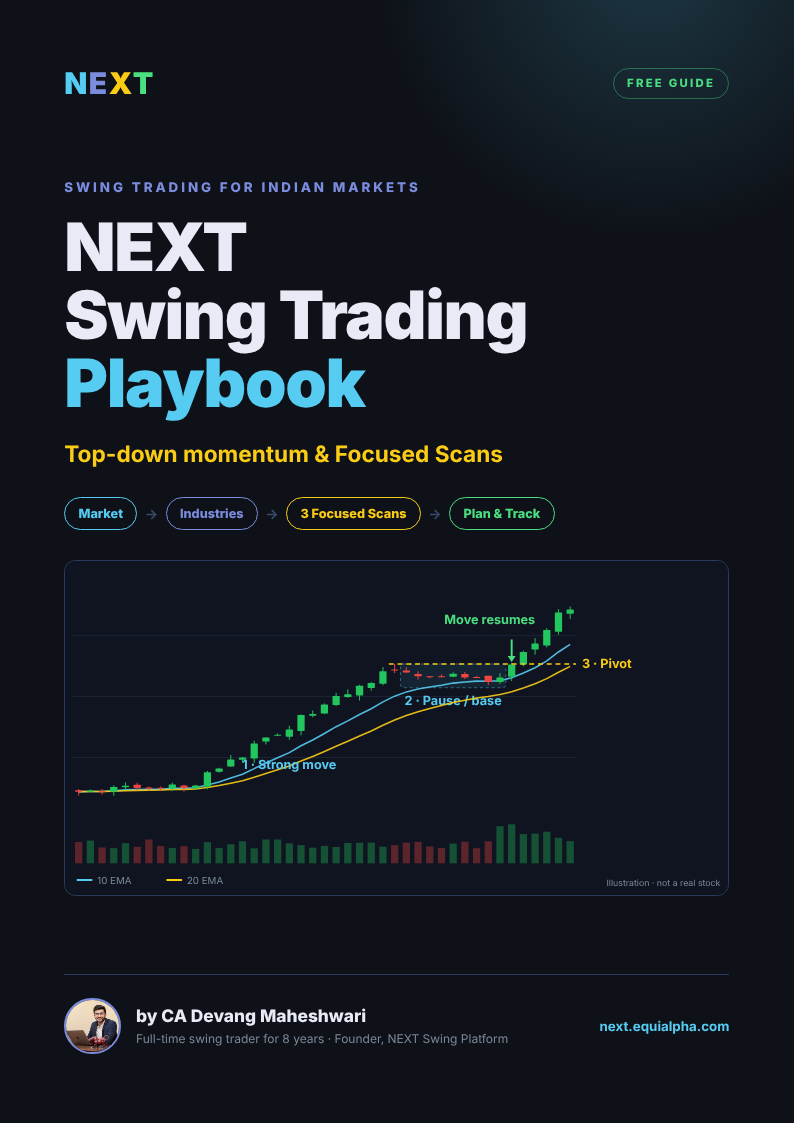
The free NEXT Swing Trading Playbook — 11 chapters, charts and printable checklists.

Written by CA Devang Maheshwari — full-time swing trader for 8 years, founder of Equialpha and builder of N.E.X.T, the swing trading platform for Indian markets. About Devang