How many days make a coil?
Usually a few sessions, often around three to five small candles. The point is the tightness of the range, not an exact day count.
Swing trading glossary
A coil is a very tight range of small candles inside a base, where price barely moves for a few days before its next move.
Inside a good base, the range often gets smaller and smaller. At the tightest point, you see a few small candles with highs and lows close together. That quiet, tight area is called a coil.
A coil matters because it shows that selling pressure has dried up. Holders are not rushing to exit, and the stock is resting in a narrow band. When price leaves a tight coil, the move can be quick because there is little supply left in the way.
Coils are useful for planning risk. The high of the coil can act as an early trigger, and the low of the coil gives a tight, logical place for a stop-loss. A tighter stop means you can size the position properly while keeping the rupee risk the same.
A coil is not a signal by itself. It needs a strong stock in a healthy base, ideally in a strong industry and a supportive market. Coils that sit right under heavy resistance leave little room before the next hurdle. When reviewing charts in the evening, the right side of the base is where to look. A stock that is quiet, tight and holding near the top of its base is often more useful to watch than one that is still swinging widely.
Inside a base between ₹460 and ₹500, a stock spends four days between ₹492 and ₹498 with small candles and low volume. That ₹492–₹498 band is the coil; a stop just under ₹492 keeps risk small.
Usually a few sessions, often around three to five small candles. The point is the tightness of the range, not an exact day count.
Not exactly. A VCP is a whole base with contractions getting smaller; the coil is the tightest part, often near the end of such a base.
Related terms
N.E.X.T reads the market, ranks 65+ industries and runs focused momentum scans across 2,100+ NSE stocks every day.
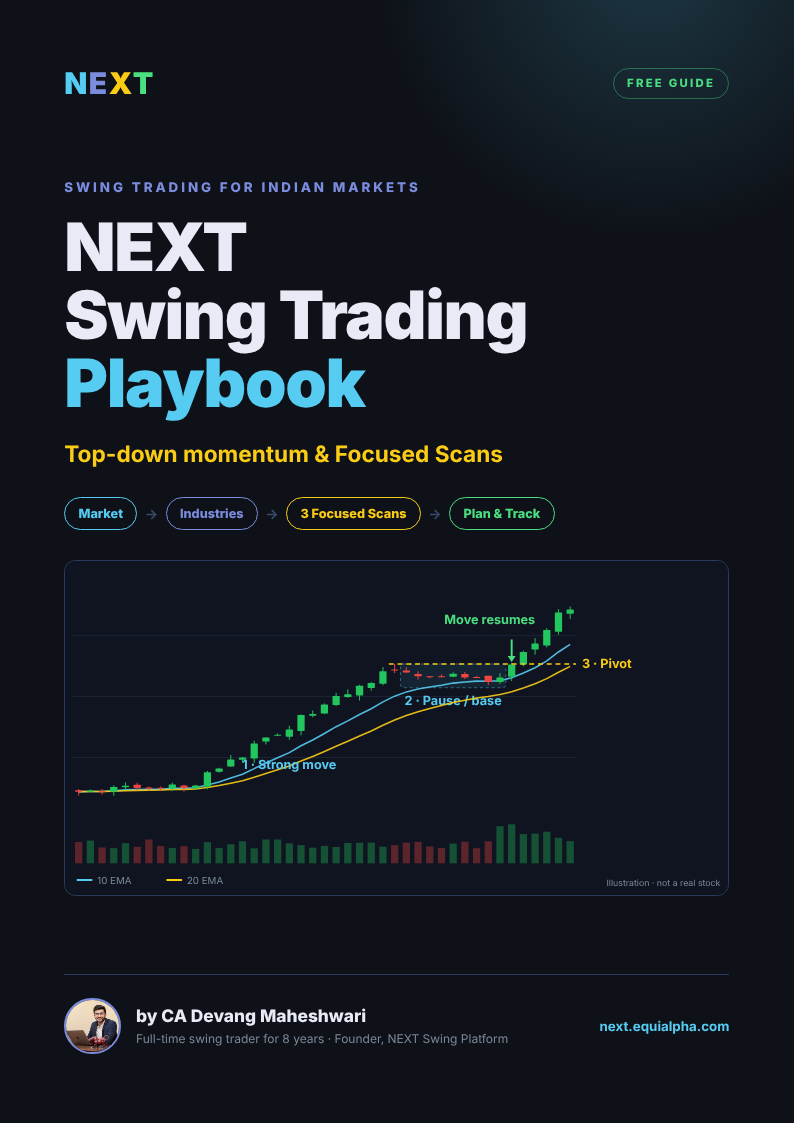
Get every guide in one PDF
The free NEXT Swing Trading Playbook — 11 chapters, charts and printable checklists.

Written by CA Devang Maheshwari — full-time swing trader for 8 years, founder of Equialpha and builder of N.E.X.T, the swing trading platform for Indian markets. About Devang