How long does an IPO base take to form?
It varies, often from a couple of weeks to a few months after listing. What matters is a clear range that tightens, not a fixed number of days.
Swing trading glossary
An IPO base is the first sideways range a newly listed stock forms after listing, before its first proper trend.
An IPO base is the first consolidation a stock builds after it lists. Early trading is often volatile as listing-day buyers and sellers settle down. Over the following weeks, the stock may stop swinging wildly and form a range with a clear high.
Swing traders watch IPO bases because new companies have no overhead supply from older buyers, and a fresh story can attract strong demand. When a well-formed IPO base breaks above its high on good volume, it can mark the start of the stock's first real advance.
Quality matters. Healthier IPO bases usually tighten over time, with smaller swings and drying volume, and hold well above the listing lows. Very wide, loose ranges or bases that keep breaking their lows are harder to trade.
Liquidity is a special concern. Some new listings trade thinly, which makes the pattern less reliable and exits harder. Position size and stop placement deserve extra care because there is little price history to work with. Patience usually pays with new listings. Watching how the stock behaves around its listing price and early highs, and waiting for the range to tighten, gives a clearer pivot and a more logical stop than buying in the noise of the first few sessions.
A stock lists at ₹300, swings between ₹270 and ₹360 for two weeks, then settles into a tighter ₹320 to ₹350 range for a month. The ₹350 high becomes the pivot of its IPO base.
It varies, often from a couple of weeks to a few months after listing. What matters is a clear range that tightens, not a fixed number of days.
They can be, because there is little price history and liquidity may be thin. Smaller position sizes and clear stops help manage that.
Related terms
N.E.X.T reads the market, ranks 65+ industries and runs focused momentum scans across 2,100+ NSE stocks every day.
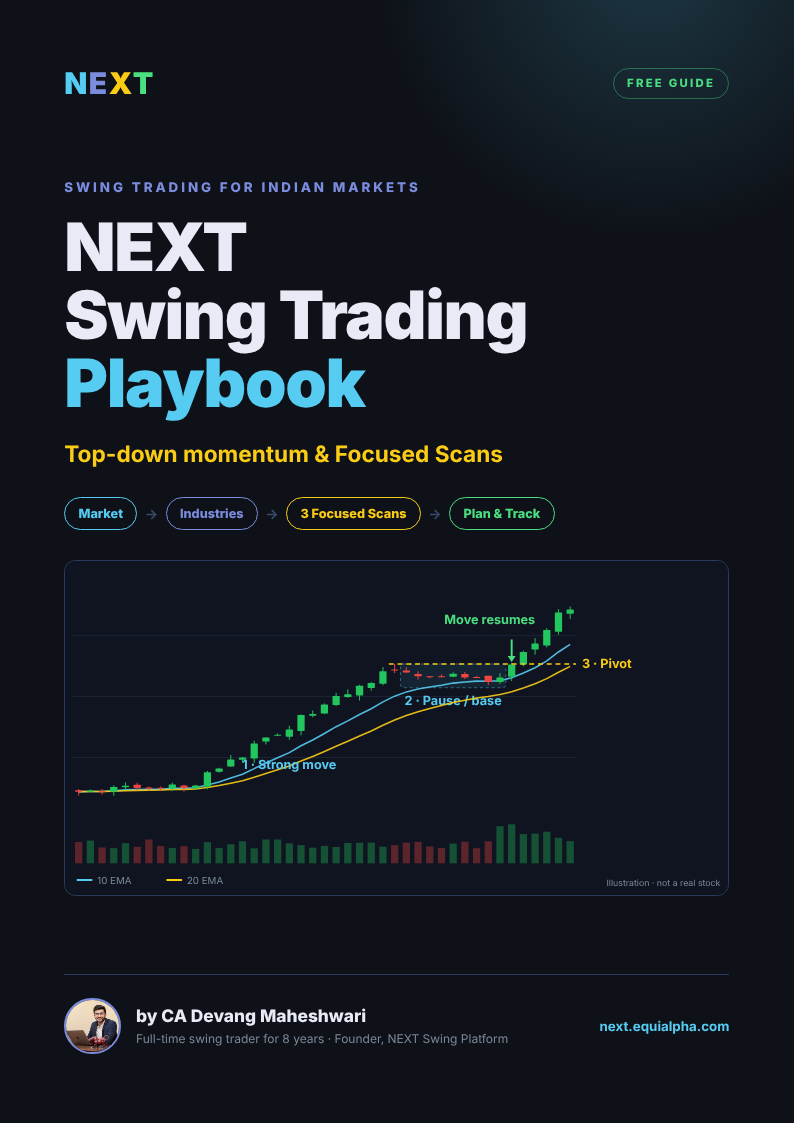
Get every guide in one PDF
The free NEXT Swing Trading Playbook — 11 chapters, charts and printable checklists.

Written by CA Devang Maheshwari — full-time swing trader for 8 years, founder of Equialpha and builder of N.E.X.T, the swing trading platform for Indian markets. About Devang