Swing trading basics

Swing Trading Setups: What They Are and the 3 We Use

A setup is the difference between “this chart looks nice” and “this chart matches a structure I understand, with a price level I can plan around.” Here's what setups are, and the three we focus on.

By CA Devang Maheshwari · Updated 2 November 2026

Quick answer

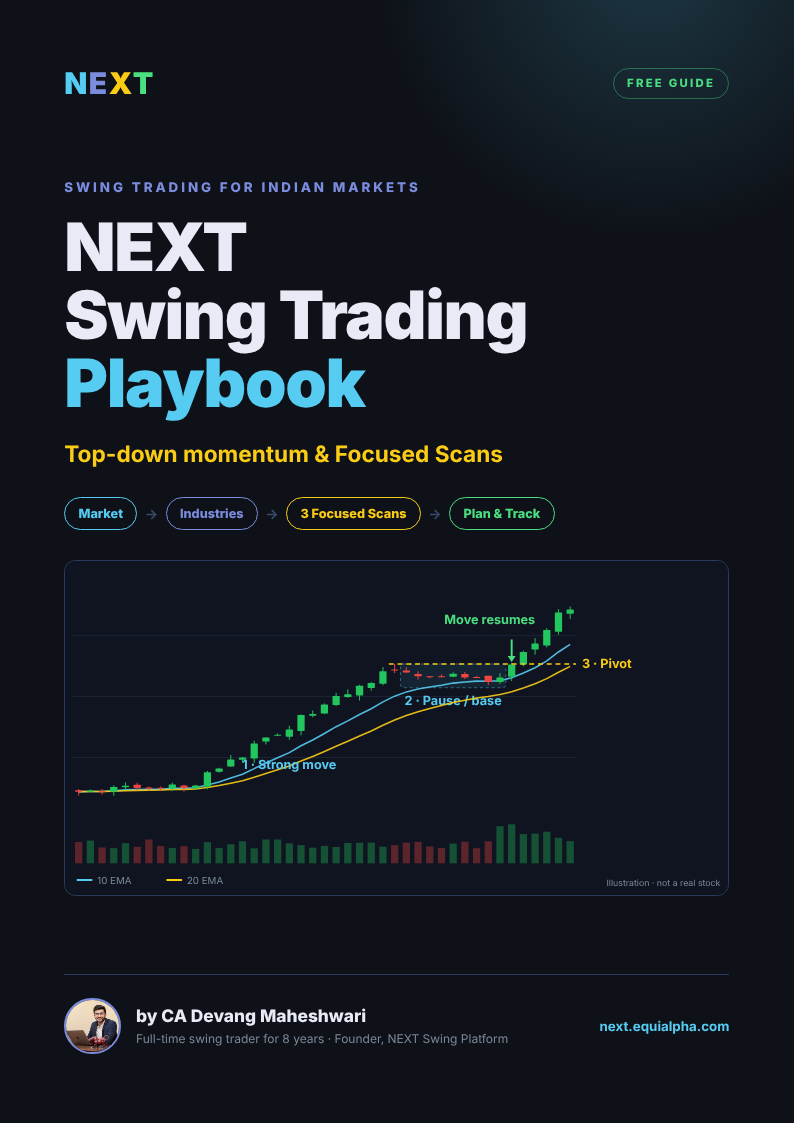
A swing trading setup is a defined chart structure — usually a strong move, a pause or base, and a pivot level — that tells you which price to watch and when the idea is wrong. N.E.X.T focuses on three momentum setups for Indian stocks: Follow Through Swing, 20 EMA Base and IPO Base. A setup frames the decision; it never guarantees the outcome.

Every setup has the same three parts

Different shapes, same logic.

Step 1
A strong move

The stock shows real buying strength — not a one-day jump

Step 2
A pause or base

Price rests and tightens instead of falling apart

Step 3
A pivot level

The exact price that shows the move is resuming

The pause tells you buyers are still in control. The pivot tells you when to pay attention.

What is a swing trading setup?

A setup is a set of rules for a tradable structure. Instead of reacting to every green candle, you wait for a stock to form a specific shape that you've studied — and the setup gives you a pivot: the price level that tells you the stock is moving the way the structure suggests.

Think of it like a cricket batter waiting for a ball in their zone. Plenty of balls come; a good batter plays the ones they've practised for.

Key idea

A setup frames a decision — what to watch, where the idea is wrong, how much to risk. It does not tell you a stock will go up.

Why setups beat random entries

You know what you're waiting for

Fewer impulse trades. You act on structures you've studied, not on noise.

Risk is defined before you enter

Every setup has a level where the idea is clearly wrong, so position size can be planned.

You can review and improve

When every trade belongs to a setup, your journal shows which setups work for you and which don't.

You stop chasing

If price has already run far past the pivot, the setup says “late” — not “buy anyway”.

The 3 momentum setups on N.E.X.T

N.E.X.T deliberately keeps this list short. Instead of dozens of filters, it focuses on three momentum structures that work in Indian markets — each built on a strong stock pausing before its next leg.

1. Follow Through Swing

A strong run into a pivot high, then a short pause that holds the 10 EMA — and the next leg up. Built for fast-moving leaders. Read more

2. 20 EMA Base

A leading stock pulls back to its 20 EMA, coils tight, then breaks out. Built for strong stocks resetting before the next move. Read more

3. IPO Base

A fresh listing pauses near its high and forms its first base before following through. Built for new listings with strong early demand. Read more

Follow Through Swing20 EMA BaseIPO Base
Stock typeFast-moving leaderLeader resetting after a strong advanceNew listing
The pauseShort, holds the 10 EMAPulls back to the 20 EMA, then tightensRests near the listing high
Base lengthShort (days)A few days to several weeksA few days to a few weeks
What you watchPivot highPivot high, or the tight-coil highHighest high since listing

Exact rules — depth limits, run-up ranges, liquidity checks — are built into the N.E.X.T scans.

A setup only works in the right market

The same setup behaves very differently in a strong market and a weak one. A method that works well in a supportive phase can struggle badly in a difficult phase. That's why N.E.X.T reads in a top-down order: market direction first, then which industries are strong, and only then the setups.

How the three steps fit together

  1. Market — Is the market in an uptrend, a downtrend, or trying to turn? This decides how active to be.
  2. Industries — Which of 65+ industries have momentum? Setups inside strong industries get a tailwind.
  3. Focused scans — Which stocks match Follow Through Swing, 20 EMA Base or IPO Base today?
  4. Your plan — Check the chart, mark the pivot and stop, size the position — or skip it.

Common mistakes with setups

  • Forcing a setup onto a chart that only half-matches it.
  • Entering far above the pivot after the move has already happened.
  • Ignoring the market — taking every setup even when breakouts keep failing.
  • Trading too many setup types before mastering one or two.
  • Skipping the stop because the chart “looks strong”.

Watch out

No setup wins every time. The goal is a repeatable process where losses stay small and good moves are allowed to run.

Frequently asked questions

What is a setup in swing trading?

A setup is a defined chart structure — a strong move, a pause or base, and a pivot level — that tells a swing trader which price to watch and where the idea is wrong. It frames the decision; it doesn't guarantee a winning trade.

What are the best swing trading setups for Indian stocks?

There's no single best setup. Momentum setups that combine a strong move with a tight pause are popular because risk can be defined clearly. N.E.X.T focuses on three: Follow Through Swing, 20 EMA Base and IPO Base.

How many setups should a beginner trade?

One or two. Learn how a setup behaves in different market conditions, journal every trade, and add another only when the first is well understood.

What is a pivot in a swing trading setup?

The pivot is the price level that shows the stock is resuming its move — usually the high of the base or pause. It's the level to watch; entering far above it means chasing.

Do setups work in a falling market?

Far less reliably. Breakouts fail more often when the overall market is weak, which is why market direction comes first in a top-down approach.

Where can I see stocks that match these setups?

Inside N.E.X.T, the three momentum scans list stocks that currently match each setup, with the pivot and reference levels drawn on the chart for your own review.

See the three setups on real charts

Watch the N.E.X.T walkthrough to see how market direction, industry strength and the three momentum scans work together.

Get every guide in one PDF

The free NEXT Swing Trading Playbook — 11 chapters, charts and printable checklists.

Keep reading

Browse all guides →
CA Devang Maheshwari

Written by CA Devang Maheshwari — full-time swing trader for 8 years, founder of Equialpha and builder of N.E.X.T, the swing trading platform for Indian markets. About Devang