What is the difference between support and resistance?
Support is a zone below price where buying has stopped falls before; resistance is a zone above price where selling has stopped rises before.
Swing trading glossary
Support is a price zone where buying tends to appear; resistance is a zone where selling tends to cap the price.
Support and resistance are areas on a chart where price has reacted before. Support sits below the current price, where buyers previously stepped in and stopped a fall. Resistance sits above, where sellers previously stopped a rise. They are zones, not exact prices.
These levels matter because many traders watch the same prior highs and lows. When price approaches resistance, holders who bought earlier at that level may sell to get out, which slows the advance. When price breaks above resistance and holds, that supply has been absorbed, and the old resistance often acts as support on later pullbacks.
For swing traders, the top of a base is a key resistance level, and clearing it is what a breakout means. Recent swing lows and rising moving averages act as support and are common places to set a stop-loss.
Support and resistance are more reliable when they line up with volume and the broader trend. A level tested many times in a weak market can give way easily. On a daily chart, the clearest levels are recent swing highs and lows that many traders can see without drawing lines everywhere.
A stock stalls near ₹500 three times over two months, so ₹500 is resistance. It finally closes at ₹515 on strong volume. Later it pulls back to about ₹502 and bounces, showing the old ₹500 resistance acting as support.
Support is a zone below price where buying has stopped falls before; resistance is a zone above price where selling has stopped rises before.
Once price breaks above a resistance zone and the sellers there are absorbed, buyers often defend that same zone on the next pullback.
Related terms
N.E.X.T reads the market, ranks 65+ industries and runs focused momentum scans across 2,100+ NSE stocks every day.
Get every guide in one PDF
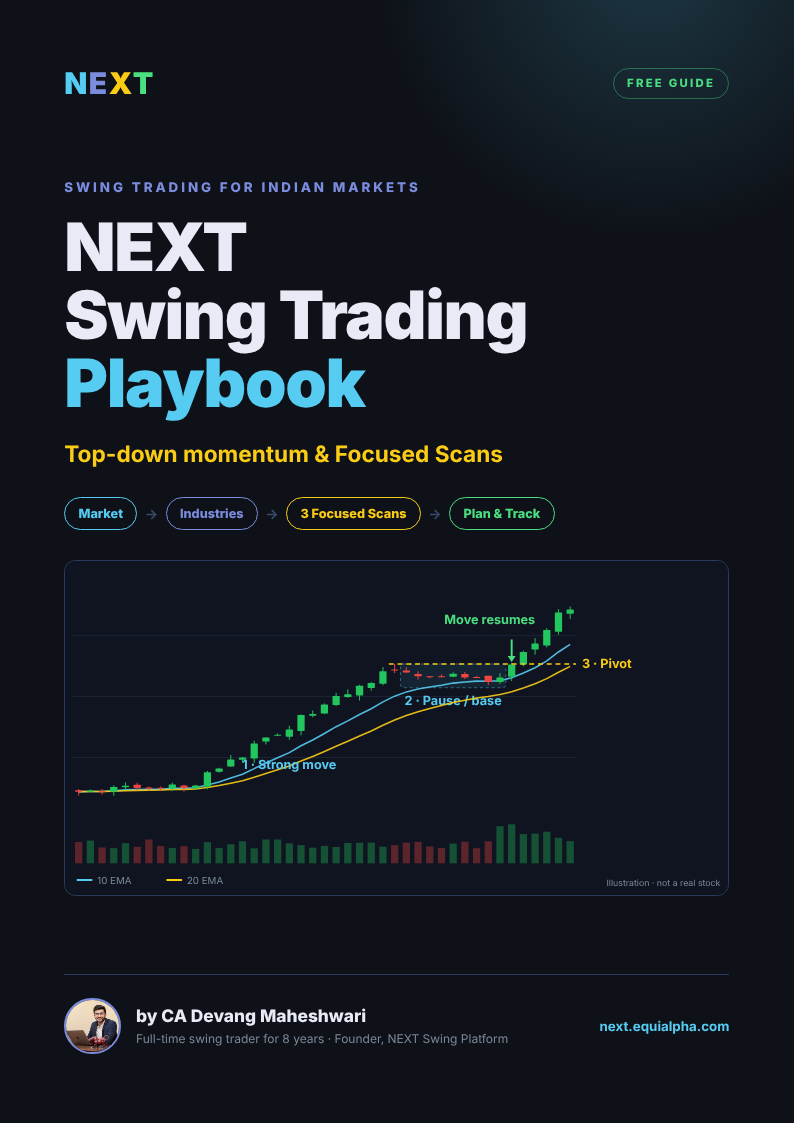
The free NEXT Swing Trading Playbook — 11 chapters, charts and printable checklists.

Written by CA Devang Maheshwari — full-time swing trader for 8 years, founder of Equialpha and builder of N.E.X.T, the swing trading platform for Indian markets. About Devang