How do I know if a stock is in Stage 2?
Look for price above rising 50 and 200-day averages, higher highs and higher lows, and a breakout from a longer base. If most of these are true, the stock is likely in Stage 2.
Swing trading glossary
Stage 2 is the advancing stage of a stock's cycle: higher highs, higher lows and rising moving averages.
Stocks tend to move through four broad stages. Stage 1 is a basing period where price moves sideways after a decline. Stage 2 is the advancing stage, where the stock trends up. Stage 3 is topping, where the trend stalls. Stage 4 is the decline.
Swing traders who follow momentum focus on Stage 2. In this stage you see higher highs and higher lows, price above rising 50 EMA and 200-day averages, and pullbacks that get bought. This is where the trend is working with you rather than against you.
Spotting Stage 2 is mostly about structure. Is the stock above its rising longer-term averages? Has it broken out of a long base? Are pullbacks holding above key averages? Early Stage 2, just after the stock leaves a long base, often offers cleaner setups than late Stage 2, after a very long run.
Stages are only clear in hindsight at times. The goal is not to label every chart perfectly, but to avoid trading against the bigger trend. Reviewing the weekly chart alongside the daily chart helps here, because the stage is easier to see when the day-to-day noise is smoothed out.
A stock moves sideways between ₹150 and ₹190 for eight months, then closes above ₹190 and climbs to ₹260 over the next quarter, staying above a rising 50 EMA. It has moved from Stage 1 into Stage 2.
Look for price above rising 50 and 200-day averages, higher highs and higher lows, and a breakout from a longer base. If most of these are true, the stock is likely in Stage 2.
Not always, but late Stage 2 bases tend to be riskier because the stock has already run a long way. Many traders prefer earlier bases in the stage.
Related terms
N.E.X.T reads the market, ranks 65+ industries and runs focused momentum scans across 2,100+ NSE stocks every day.
Get every guide in one PDF
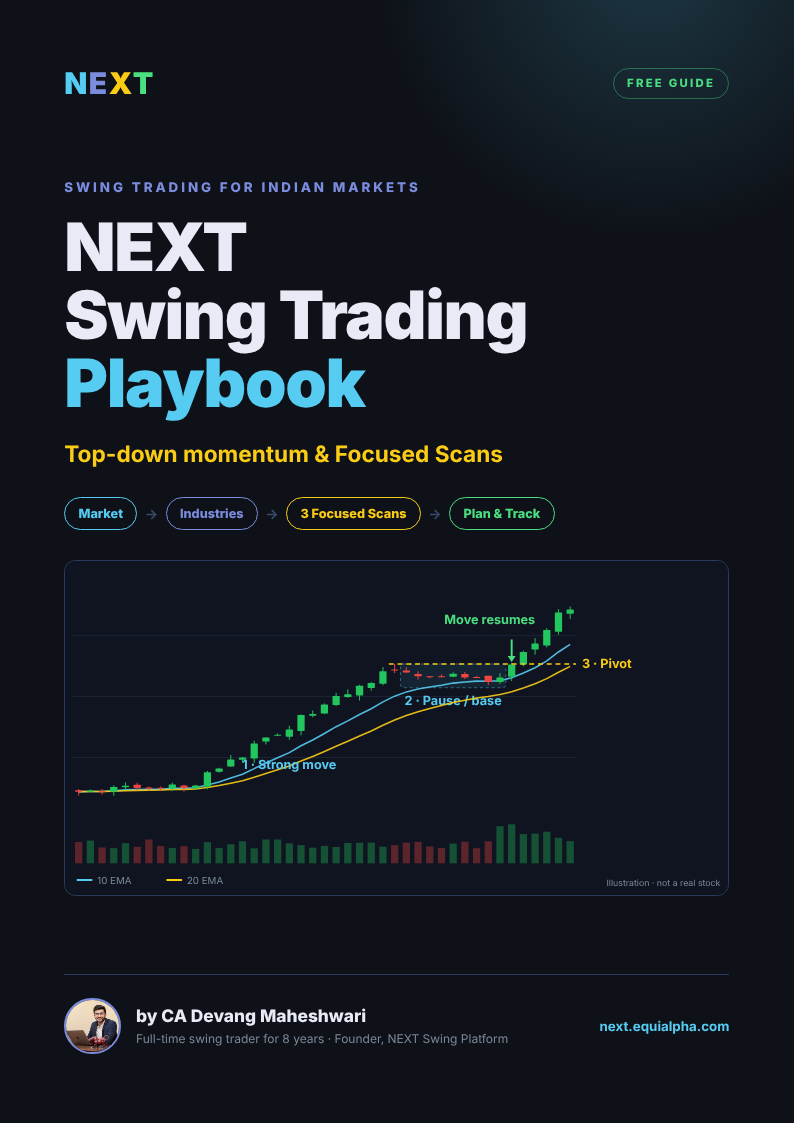
The free NEXT Swing Trading Playbook — 11 chapters, charts and printable checklists.

Written by CA Devang Maheshwari — full-time swing trader for 8 years, founder of Equialpha and builder of N.E.X.T, the swing trading platform for Indian markets. About Devang