What is the minimum amount to start swing trading in India?
There's no fixed minimum. Start with an amount you can afford to lose while learning and keep the risk per trade to about 0.5–1% of capital.
Risk & money
There's no fixed minimum. What matters is that each trade risks only a small part of your capital — and that you start with money you can afford to lose while learning.
By CA Devang Maheshwari · Updated 2 November 2026
There's no fixed minimum to start swing trading in India. Start with an amount you can afford to lose while learning, and keep the loss on any one trade to about 0.5–1% of capital. With ₹1,00,000, a 1% risk is ₹1,000 per trade. Too little capital makes brokerage and charges a big share of each trade; too much too early magnifies beginner mistakes.
Money you can afford to learn with
About 0.5–1% of capital
Entry − stop-loss
Risk ÷ stop distance
You can buy a single share, so technically you can start with very little. But swing trading works through many small, controlled losses and a few larger gains. Your capital needs to be large enough to take several positions and absorb a losing streak, while each loss stays small.
Key idea
The question isn't “how much do I need?” but “how much can I afford to lose while I learn?” Start there.
| Capital | 1% risk per trade | Example: ₹20 stop distance | Position value at ₹400 entry |
|---|---|---|---|
| ₹50,000 | ₹500 | 25 shares | ₹10,000 (20%) |
| ₹1,00,000 | ₹1,000 | 50 shares | ₹20,000 (20%) |
| ₹5,00,000 | ₹5,000 | 250 shares | ₹1,00,000 (20%) |
| ₹10,00,000 | ₹10,000 | 500 shares | ₹2,00,000 (20%) |
Illustrative. The stop distance comes from your chart; try your own numbers in the free position size calculator.
Notice that the percentages stay the same — the method scales with capital. What changes is how much brokerage, taxes and other charges take out of each trade.
Tip
If charges eat most of a typical winning trade, the capital per trade is too small. Fewer, slightly larger positions with the same percentage risk usually work better.
Watch out
Never trade with borrowed money or money you need for living expenses. No method wins every trade.
There's no fixed minimum. Start with an amount you can afford to lose while learning and keep the risk per trade to about 0.5–1% of capital.
Yes, technically. But with very small amounts, brokerage and charges take a large share of each trade, and you can hold only one or two positions. Treat it as a learning amount.
Many swing traders risk 0.5–1% of capital per trade, and less when the market is weak.
Often a handful — enough to spread risk, few enough to manage. Your total open risk (all stops hit) matters more than the count.
When your journal over many trades shows the process works for you — not after a single winning streak.
N.E.X.T includes a Qty Calculator and a Trade Journal, so every trade is sized from the stop and reviewed in R.
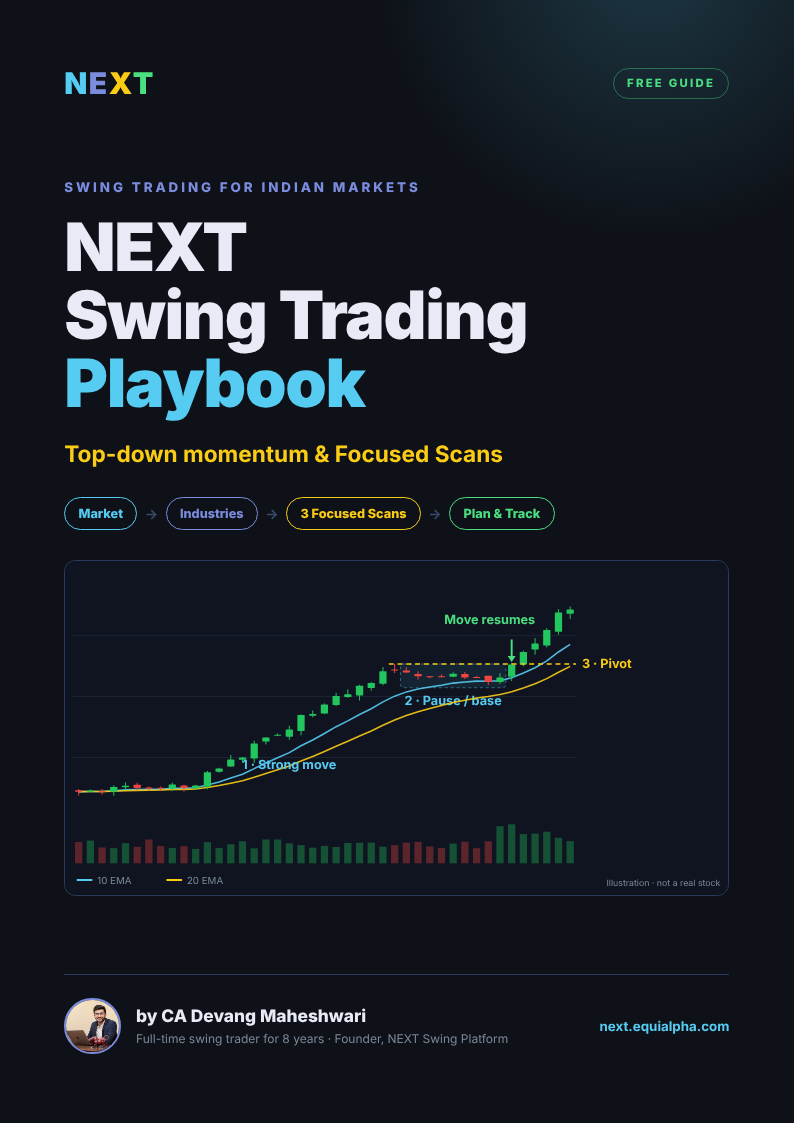
Get every guide in one PDF
The free NEXT Swing Trading Playbook — 11 chapters, charts and printable checklists.

Written by CA Devang Maheshwari — full-time swing trader for 8 years, founder of Equialpha and builder of N.E.X.T, the swing trading platform for Indian markets. About Devang