Where should I put my stop-loss in swing trading?
Below the base low — where the setup is clearly broken — or a fixed percentage below your entry, such as 5%. Decide it before you buy.
Risk & money
A stop-loss is the price where your trade idea is clearly wrong. Decide it before you buy, and it does two jobs: it caps the loss and it tells you how many shares to buy.
By CA Devang Maheshwari · Updated 2 November 2026
In swing trading, put the stop-loss either below the base low — the level where the setup is clearly broken — or at a fixed percentage below your entry (for example 5%). Decide it before you buy, size the position from the distance to the stop, and never move it lower. Raising it as the trade works is fine.
Where you'd enter
Below the base, or a fixed %
Risk ₹ ÷ (entry − stop)
Only now
The stop goes just under the lowest point of the base or the last tight area. If price gets there, the structure that made you buy has failed. Logical, chart-based.
The stop sits a set percentage under your entry — for example 5%. Simple and consistent across trades, and it stops one bad trade from being much bigger than the rest. Simple, rule-based.
Entry, stop and risk
Many traders combine the two: they use the base low, but if that is more than their maximum percentage away, they either take a smaller position or skip the trade.
The stop is what turns a chart idea into a number. Decide how many rupees you'll lose if the stop is hit — say 1% of capital — and divide by the distance to the stop.
| Tight stop | Wide stop | |
|---|---|---|
| Capital | ₹5,00,000 | ₹5,00,000 |
| Risk (1%) | ₹5,000 | ₹5,000 |
| Entry / stop | ₹412 / ₹392 | ₹412 / ₹372 |
| Risk per share | ₹20 | ₹40 |
| Quantity | 250 shares | 125 shares |
Same ₹5,000 risk either way — a wider stop means fewer shares, not more risk. Try it in the free position size calculator.
Watch out
Gaps can open below your stop. A stop limits loss in normal trading, not in every case — another reason to keep position sizes sensible.
Key idea
A stop-loss isn't a sign of being wrong about trading — it's what makes swing trading survivable. Small losses are the cost of finding the moves that work.
Below the base low — where the setup is clearly broken — or a fixed percentage below your entry, such as 5%. Decide it before you buy.
Many swing traders keep stops between about 3% and 8% below entry, depending on the stock and the setup. Tighter bases allow tighter stops.
Many do once a trade is working: move the stop to breakeven, then trail it under a rising moving average or under recent swing lows. Never move it lower.
Either can work; what matters is choosing one rule before you enter and sticking to it.
Quantity = rupee risk per trade ÷ (entry − stop). A wider stop means fewer shares, so the rupee risk stays the same.
N.E.X.T draws the reference stop on Follow Through Swing and IPO Base charts, and its Qty Calculator sizes every trade from your stop.
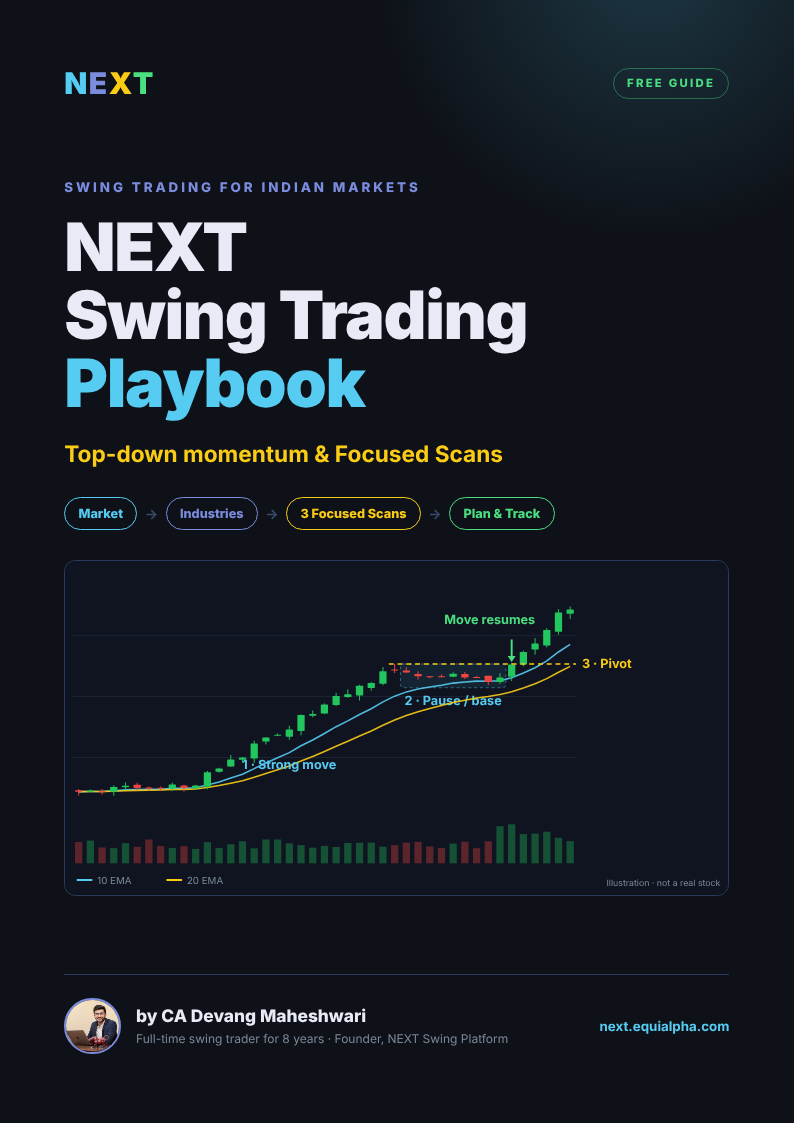
Get every guide in one PDF
The free NEXT Swing Trading Playbook — 11 chapters, charts and printable checklists.

Written by CA Devang Maheshwari — full-time swing trader for 8 years, founder of Equialpha and builder of N.E.X.T, the swing trading platform for Indian markets. About Devang