What is swing trading in simple words?
Swing trading is holding a stock for days to weeks to capture one meaningful leg of its price move. Swing traders use daily charts, defined setups and a stop-loss on every trade.
Beginner's roadmap
Swing trading sits between staring at screens all day and holding stocks for years. Here's what it is, the few ideas you actually need, and a sensible order to learn them in.
By CA Devang Maheshwari · Updated 2 November 2026
Swing trading means participating in a price move that lasts days to weeks — typically from about 8–10 sessions up to around 2 months — using daily charts. You look for strong stocks in a supportive market, wait for a defined setup with a clear pivot and stop-loss, and size each position so a loss stays small. It suits working professionals in India because decisions can be made after the NSE close.
From thousands of stocks to one planned decision.
Is the overall market helping or hurting?
Momentum and trend, not one-day jumps
A defined structure with a price to watch
Stop-loss and position size before entry
Each stage narrows the list. What's left is a candidate to evaluate, not an automatic entry.
Swing trading is participating in a price move over days to weeks. You aren't trying to catch every tick, and you aren't buying to hold for a decade. You're trying to ride one meaningful leg of a stock's move — then step aside.
What a swing trade looks like
Think of it like a batter rotating the strike and hitting the loose balls, rather than defending every delivery (intraday) or batting for two full days (long-term investing).
| Intraday | Swing trading | Investing | |
|---|---|---|---|
| Holding time | Minutes to hours | Roughly 8–10 sessions to 2 months | Months to years |
| Main chart | Minute charts | Daily candles | Weekly charts, financials |
| Screen time | Most of the trading day | An hour or so after the close | Occasional review |
| What drives it | Very short-term price swings | Trend, momentum and setups | Business growth and valuation |
Holding horizon is guided by price action and market conditions, not a fixed calendar.
Swing trading has a lot of jargon, but six ideas carry most of the weight. Learn these before anything else.
Trend, base and pivot on one chart
Direction of price. An uptrend makes higher highs and higher lows; rising, aligned 10 and 20 EMAs help confirm it.
The strength and pace of a move — sustained buying strength, not a one-day jump.
A pause where price rests and tightens after a strong move instead of falling apart.
The price level — often the high of the base — that shows the move may be resuming.
The price where your idea is clearly wrong and you exit. Decided before you enter.
How many shares you buy so that hitting the stop costs only a small, planned part of your capital.
Key idea
One strong green candle is not a trend. Look for a pattern of higher highs, higher lows and aligned moving averages.
If you want a structured path, compare options in our guide to the best swing trading courses in India. For a deeper walk-through of every stage, read the long swing trading guide for India.
Because swing trading uses daily candles, you don't need to watch the market between 9:15 AM and 3:30 PM IST. Most of the work happens in the evening.
Tip
Doing nothing is a valid decision. On many days, the best plan is to wait.
Plan the risk before the trade
Watch out
No method wins every trade. Swing trading works through small losses, a few larger gains and the discipline to follow the same process repeatedly.
Swing trading is holding a stock for days to weeks to capture one meaningful leg of its price move. Swing traders use daily charts, defined setups and a stop-loss on every trade.
Typically from about 8–10 trading sessions up to around 2 months. The exact holding period is guided by price action and market conditions rather than a fixed date.
It can be, because decisions are made on daily charts after the NSE close and don't need constant screen time. Beginners should start small, master one setup and use a stop-loss on every trade.
There's no fixed minimum, but start with an amount you can afford to lose while learning. What matters more is position sizing — keeping the loss on any one trade to a small part of capital.
Yes. Most swing trading work — checking the market, scanning and planning — can be done in an hour or so after the 3:30 PM IST close, with orders placed the next day.
Intraday positions open and close on the same day using minute charts. Swing trades are held for days to weeks using daily charts, so they need less screen time but carry overnight moves.
Watch the N.E.X.T walkthrough to see market direction, strong industries and three focused momentum scans come together for Indian stocks.
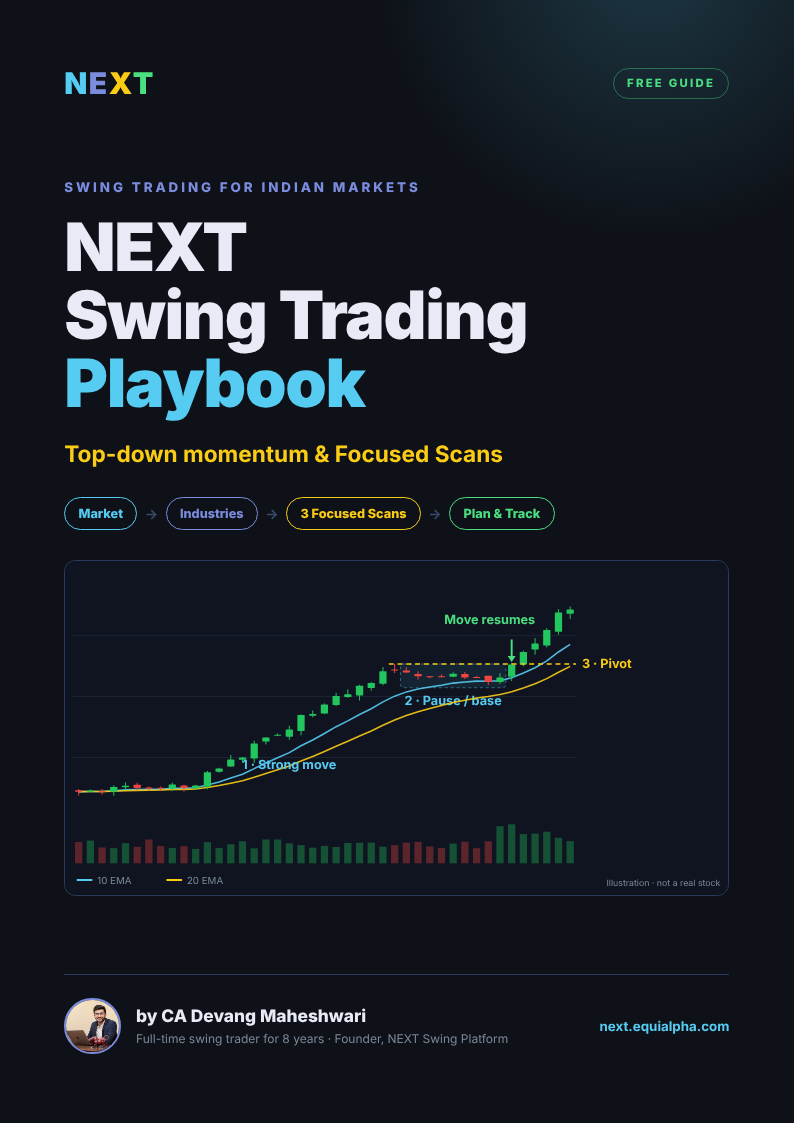
Get every guide in one PDF
The free NEXT Swing Trading Playbook — 11 chapters, charts and printable checklists.

Written by CA Devang Maheshwari — full-time swing trader for 8 years, founder of Equialpha and builder of N.E.X.T, the swing trading platform for Indian markets. About Devang