What is momentum trading?
Momentum trading is buying stocks that show sustained buying strength — a rising, aligned trend — and holding while that strength lasts. It follows what price is doing rather than predicting it.
Momentum
Momentum trading is built on a simple observation: strong stocks often keep being strong for a while. The skill is telling real, sustained strength apart from a one-day spike.
By CA Devang Maheshwari · Updated 2 November 2026
Momentum trading means buying stocks that show the strength and pace of a sustained price move — consistent buying strength, not a one-day jump — and holding while that strength lasts. In India, swing traders combine price momentum, relative strength against the market and industry momentum, then enter on a defined setup with a stop-loss. It works best in a rising market and needs strict risk control because momentum can reverse sharply.
Stronger together than alone.
Is the stock's group attracting buyers?
Is it beating the market and its peers?
Is its own trend rising and aligned?
A defined entry and exit plan
When all three layers agree, the stock has a tailwind. When they disagree, caution.
Momentum is the strength and pace of a price move. A stock with momentum keeps making higher highs and higher lows, its 10 and 20 EMAs rise and stay aligned, and dips get bought.
What momentum is — and isn't
It's like a batter who is “in form”. One boundary doesn't make form; a run of good scores does. In the same way, one big green candle isn't momentum — sustained buying strength is.
Key idea
Momentum is about what price is doing, not what a company might do someday. You follow strength rather than predict it.
Relative strength in one picture
| Type | Question it answers | How it's seen |
|---|---|---|
| Price momentum | Is this stock rising on its own chart? | Higher highs and lows, rising and aligned EMAs |
| Relative strength (RS) | Is it beating the market and other stocks? | Performance compared with the index or a ranking |
| Industry momentum | Is its whole group strong? | Many stocks in the industry trending and scanning well |
A stock can rise while still lagging the market, so price momentum alone isn't enough. Learn more in RS rating explained and why industry momentum leads stocks.
Large funds can't buy their full position in a day, so their buying shows up over weeks.
Better earnings or industry changes are not fully priced in at once.
When a theme strengthens, buyers spread across many stocks in that group.
Stocks near highs get noticed, which can bring in more buyers.
None of these forces lasts forever, which is why momentum traders exit when the trend breaks rather than holding on hope.
The most common momentum mistake: chasing
Illustration only
A method that wins 50–60% of trades in a favourable phase may win only around 30% in a difficult phase. Market direction changes the odds of every setup.
N.E.X.T follows this order: market direction, then industry strength through N.E.X.T Momentum across 65+ industries, then three focused momentum scans across 2,100+ NSE stocks.
It can be, because the rules are visible on a chart: strong trend, clear pause, defined pivot, fixed stop. That's easier to learn than guessing what a business is worth.
The catch is discipline. Momentum rewards traders who cut losses quickly and punishes those who chase or hope. Start small, stick to one setup and keep a journal.
Momentum trading is buying stocks that show sustained buying strength — a rising, aligned trend — and holding while that strength lasts. It follows what price is doing rather than predicting it.
Momentum is a widely used approach in Indian markets, but it works far better in rising markets than falling ones. Results depend on stock selection, market direction and risk control.
Price momentum asks whether a stock is rising on its own chart. Relative strength asks whether it is rising faster than the market or other stocks.
Yes. Momentum stocks can reverse sharply, and late entries carry wide stops. Defined setups, stop-losses and position sizing keep each loss small.
For swing traders, typically from about 8–10 sessions up to around 2 months, depending on price action and market conditions.
Industry momentum is when many stocks in the same industry show strength together. Stocks in strong industries tend to have a tailwind compared with lone movers in weak groups.
Watch the N.E.X.T walkthrough to see market direction, N.E.X.T Momentum for industries and the three momentum scans working together.
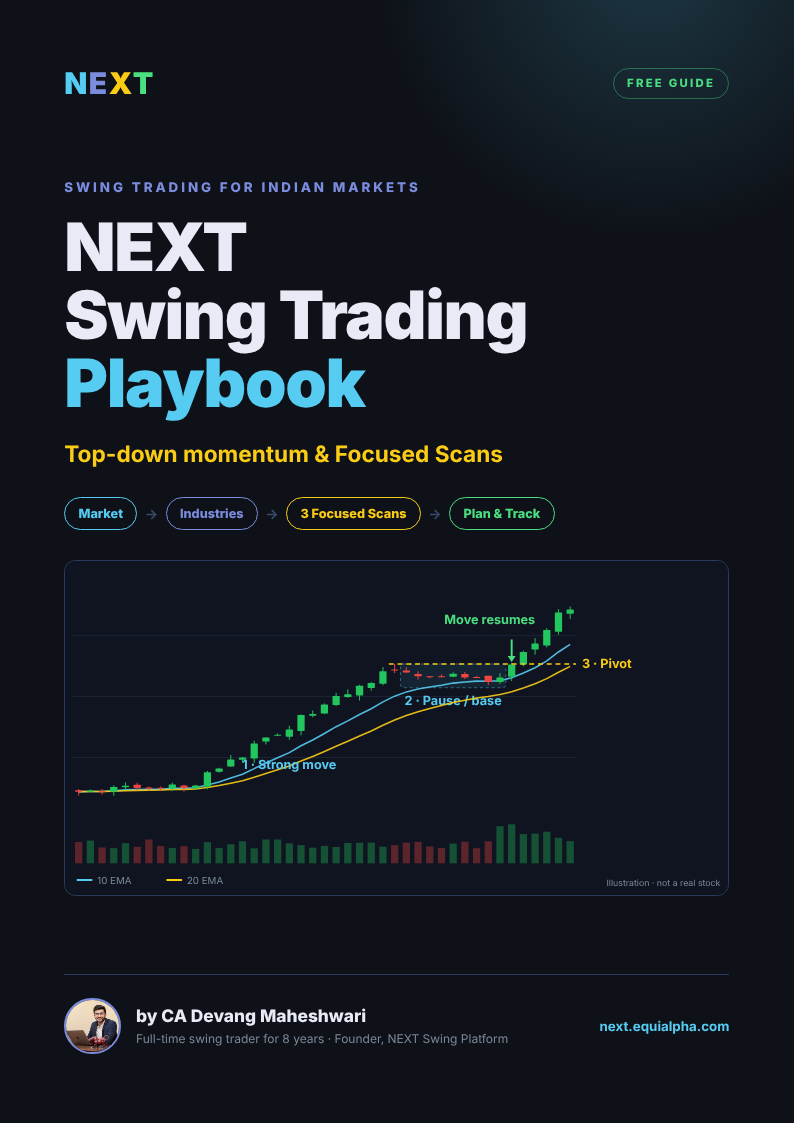
Get every guide in one PDF
The free NEXT Swing Trading Playbook — 11 chapters, charts and printable checklists.

Written by CA Devang Maheshwari — full-time swing trader for 8 years, founder of Equialpha and builder of N.E.X.T, the swing trading platform for Indian markets. About Devang