Setup guide

Follow Through Swing Setup Explained

Some of the strongest stocks never pull back much. They run, rest for a few sessions without losing their short-term trend, and then keep going. The Follow Through Swing setup is built to catch that next leg.

By CA Devang Maheshwari · Updated 2 November 2026

Quick answer

A Follow Through Swing is a momentum setup where a stock in a clear uptrend makes a strong run into a pivot high, pauses for a few sessions while closing above its 10 EMA, and then moves above that pivot. The short, shallow pause shows buyers are still in control. The pivot high is the level to watch, and a close back below the short-term trend shows the idea is weakening.

The Follow Through Swing in four stages

A strong stock that refuses to give much back.

Step 1
Strong run-up

A clear advance with aligned EMAs

Step 2
Pivot high

The top of the run — the level to watch

Step 3
Short pause

A few sessions, closes hold above the 10 EMA

Step 4
Follow through

Price moves above the pivot high

The pause is short because buyers don't let the price fall far.

What is a Follow Through Swing?

A Follow Through Swing is a stock that has already proved it is strong and is now resting briefly before the next push. It's one of the three focused momentum scans on N.E.X.T.

Think of a sprinter catching a breath between laps without sitting down. The stock pauses, but it never loses its short-term trend — closes stay above the 10 EMA and the 20 EMA isn't touched.

Key idea

The setup is about follow through: a stock that was strong yesterday continuing to be strong — not a beaten-down stock trying to turn around.

Step-by-step anatomy

How the setup forms

  1. Uptrend first — All the EMAs are aligned and rising. Ideally the stock's industry is rated Strong or Moderate.
  2. A strong run-up — The stock makes a real advance into a pivot high — not a single-day spike.
  3. The pivot high — The top of that run becomes the pivot. The stock should be near its 52-week high, not far below it.
  4. A short pause — For a few sessions price rests. Closes stay above the 10 EMA and the 20 EMA isn't touched. The base stays shallow and short.
  5. A reset after a bigger run — If the run-up was very large, the stock should touch the 10 EMA during the pause to cool off before continuing.
  6. Move above the pivot — The entry idea is a move above the pivot high. On N.E.X.T the stock stays listed for a few sessions after the breakout day.

What makes it strong — or weak

Strong: tight, quiet pause

Small candles and lower volume during the pause suggest sellers are scarce.

Strong: industry tailwind

A setup inside a Strong or Moderate industry has company — other stocks are moving too.

Weak: overextended

If the stock is already stretched far above its averages, the pause may turn into a deeper pullback.

Weak: sloppy base

Wide, choppy candles or closes slipping under the 10 EMA show buyers losing grip.

When the setup fails

Follow Through Swings move fast, and they fail fast too. The usual failure looks like this: price pokes above the pivot, can't hold it, and closes back inside the base — then slips below the 10 EMA.

  • Weak market — breakouts fail more often when the overall market is under pressure.
  • Late entry — buying well above the pivot leaves little room before a normal pullback hits your stop.
  • The pause gets too long — a short base turning into a long one means the urgency has gone.
  • Loss of the 10 EMA — closing below the short-term trend breaks the core idea of the setup.

Watch out

Plan the stop before you enter. A Follow Through Swing that loses its trend is no longer a Follow Through Swing.

Follow Through Swing vs 20 EMA Base

Follow Through Swing20 EMA Base
The pauseShort, holds above the 10 EMAPulls back to the 20 EMA, then tightens
Base lengthA few sessionsSeveral sessions, up to about six weeks
20 EMA touched?NoYes — that's the reset
Levels to watchPivot highBase pivot and the earlier coil pivot
CharacterFast continuationDeeper reset before the next leg

Exact thresholds are built into the N.E.X.T scans.

Read the full 20 EMA Base guide for how that setup works.

Where to find it on N.E.X.T

In the Chart Terminal, choose the Follow through swing playlist to flip through current candidates with the pivot and reference stop drawn on each chart. In Filtered Scan, pick Swing to see the same candidates alongside their industry and stock ratings.

These are candidates for your own review, not recommendations. Check the market and the industry, then decide whether the chart meets your plan.

Frequently asked questions

What is a Follow Through Swing setup?

It's a momentum setup where a stock in an uptrend runs into a pivot high, pauses for a few sessions while closing above its 10 EMA, and then moves above the pivot. The short pause shows buyers are still in control.

Why the 10 EMA?

The 10 EMA tracks short-term trend. A stock that keeps closing above it during a pause is showing that buyers step in quickly, which is the core of the setup.

How long is the pause in a Follow Through Swing?

Usually just a few sessions. The base stays short and shallow; a pause that drags on loses the urgency the setup depends on.

Where is the entry in a Follow Through Swing?

The entry idea is a move above the pivot high. Entering far above the pivot means chasing and leaves little room before a normal pullback.

How is it different from a 20 EMA Base?

A Follow Through Swing holds above the 10 EMA and never touches the 20 EMA. A 20 EMA Base pulls back to the 20 EMA, tightens into a coil and usually takes longer to form.

Does the Follow Through Swing work in every market?

No. It works best in a supportive market and fails more often when the market is weak, which is why N.E.X.T reads market direction before the scans.

See Follow Through Swings on real charts

Watch the N.E.X.T walkthrough to see the Terminal playlist, the pivot lines and how market and industry context frame each setup.

Get every guide in one PDF

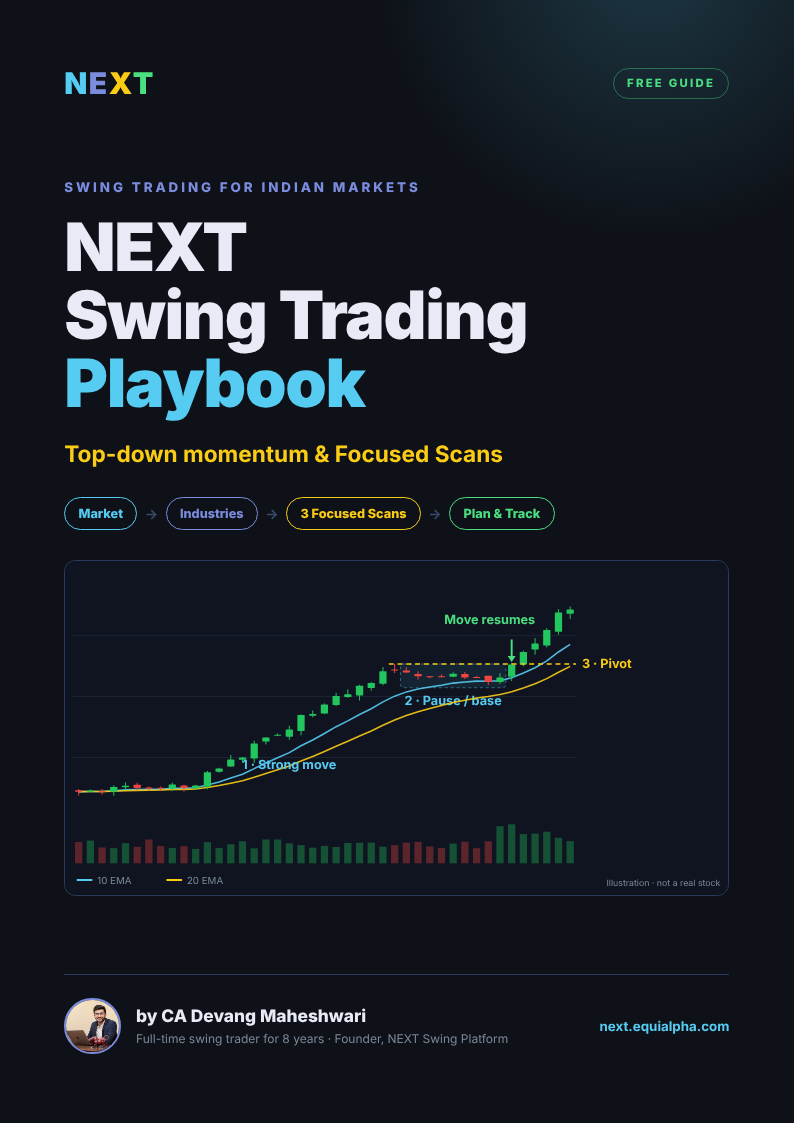
The free NEXT Swing Trading Playbook — 11 chapters, charts and printable checklists.

Keep reading

Browse all guides →
CA Devang Maheshwari

Written by CA Devang Maheshwari — full-time swing trader for 8 years, founder of Equialpha and builder of N.E.X.T, the swing trading platform for Indian markets. About Devang