Are stocks at all-time highs risky?
Every trade carries risk, but a stock at an all-time high has no overhead supply from earlier buyers. Risk is controlled with entry close to the pivot and a defined stop-loss.
Swing trading glossary
An all-time high is the highest price a stock has ever traded at, so there are no earlier buyers above it waiting to sell.
An all-time high is the highest price a stock has reached since it listed. When a stock breaks above its all-time high, every holder is in profit and there is no old resistance overhead.
This matters because overhead supply, people who bought higher and are waiting to sell at breakeven, often slows a recovery. A stock at an all-time high has none of that. That is one reason strong momentum stocks keep appearing near their highs rather than near their lows.
For swing traders, a breakout to an all-time high from a sound, tight base can be a strong setup. But it is not automatic. The stock still needs good volume, a supportive market and industry, and an entry close to the pivot rather than far above it.
Because there are no prior price levels above, traders manage these trades with a stop-loss and, later, a trailing stop rather than an obvious target. Breakouts to all-time highs can also be volatile in the first few sessions, so position size should reflect the distance to the stop, not excitement about the move.
A stock's previous peak is ₹1,500 from two years ago. After a long base it clears ₹1,500 and closes at ₹1,540 on heavy volume. A trader plans the stop below the base at ₹1,440 and trails it if the move continues.
Every trade carries risk, but a stock at an all-time high has no overhead supply from earlier buyers. Risk is controlled with entry close to the pivot and a defined stop-loss.
There are no prior levels above, so many traders use a trailing stop-loss and let the trend decide the exit.
Related terms
N.E.X.T reads the market, ranks 65+ industries and runs focused momentum scans across 2,100+ NSE stocks every day.
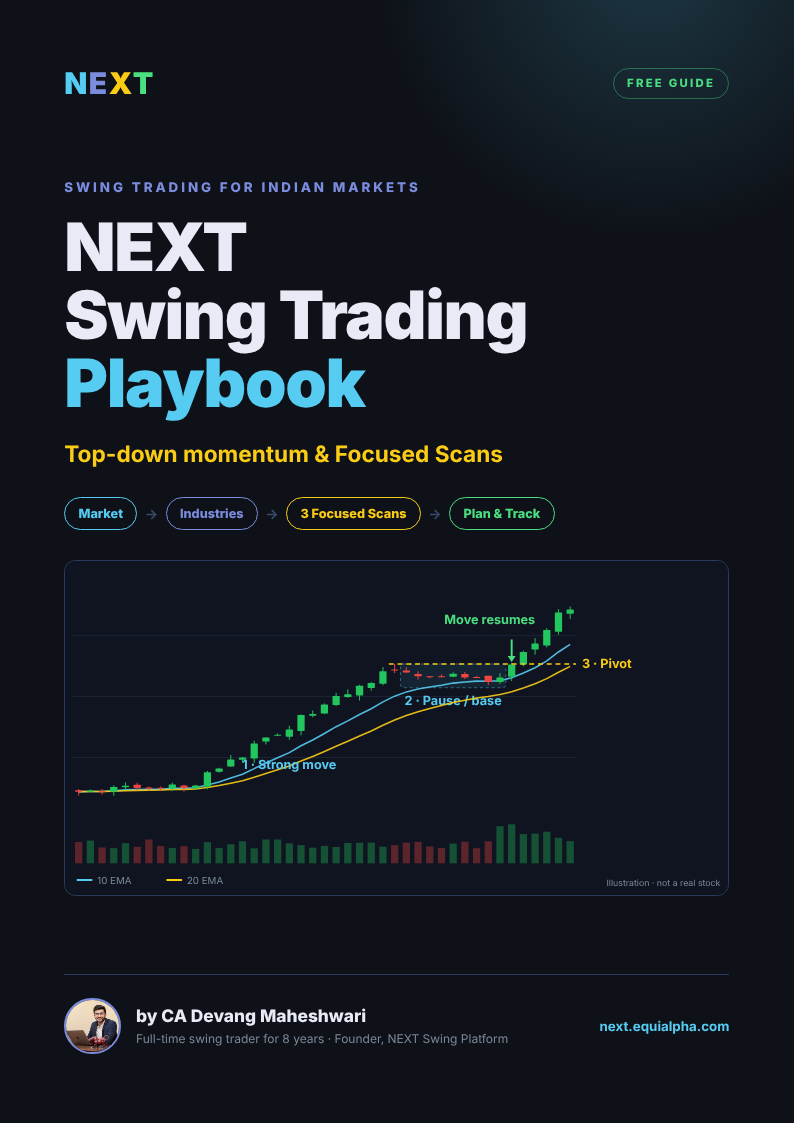
Get every guide in one PDF
The free NEXT Swing Trading Playbook — 11 chapters, charts and printable checklists.

Written by CA Devang Maheshwari — full-time swing trader for 8 years, founder of Equialpha and builder of N.E.X.T, the swing trading platform for Indian markets. About Devang