Which moving average is best for a trailing stop?
There is no single best one. Faster stocks are often trailed with the 10 EMA and steadier ones with the 20 EMA. Pick one rule and apply it consistently.
Swing trading glossary
A trailing stop-loss moves up as the price rises, locking in part of the gain while giving the trade room to keep running.
A trailing stop-loss is a stop that you raise as the trade moves in your favour. It never moves down. Once a swing trade is working, it protects open profit while still letting the stock run.
On daily charts, traders usually trail with something visible. Common choices are the low of the last few candles, a recent higher low, or a moving average such as the 10 EMA or 20 EMA. A close below that level ends the trade.
The choice of trail decides the style. A tight trail, like the 10 EMA, keeps more of a fast move but gets shaken out on normal pullbacks. A looser trail, like the 20 EMA or a swing low, gives the stock more room but gives back more profit when the move ends.
Trailing is about exits, not entries. It works best combined with a fixed initial stop: the first stop protects capital, and the trailing stop takes over once the trade has moved well beyond its starting risk. Whatever method you choose, write it down before entry and apply it the same way every time. Consistent trailing rules make your results measurable in a journal and stop each exit from becoming an emotional decision made in the middle of a move.
You buy at ₹400 with an initial stop at ₹380. The stock rises to ₹480 and its 20 EMA is now at ₹450. Trailing with the 20 EMA, your stop is raised to about ₹450, so a reversal still leaves a gain of around ₹50 per share.
There is no single best one. Faster stocks are often trailed with the 10 EMA and steadier ones with the 20 EMA. Pick one rule and apply it consistently.
Usually the initial stop protects the trade until it has moved meaningfully in your favour. Trailing too early often stops you out on the first normal pullback.
Related terms
N.E.X.T reads the market, ranks 65+ industries and runs focused momentum scans across 2,100+ NSE stocks every day.
Get every guide in one PDF
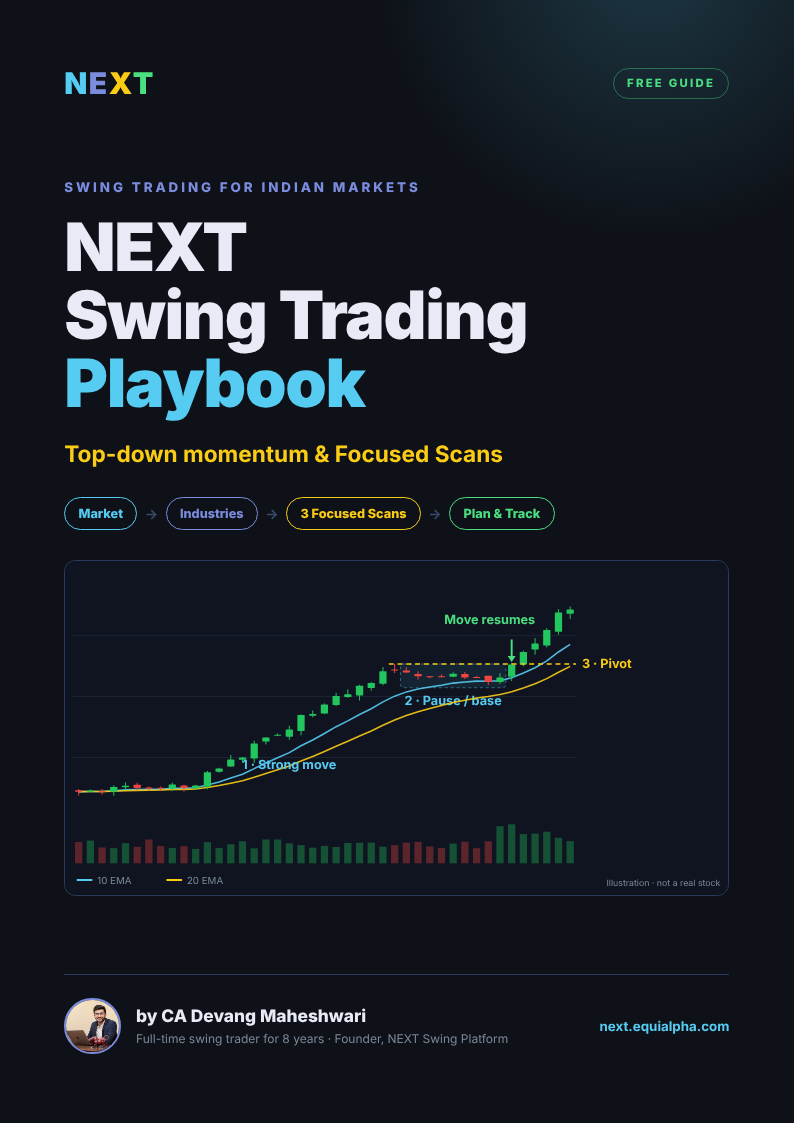
The free NEXT Swing Trading Playbook — 11 chapters, charts and printable checklists.

Written by CA Devang Maheshwari — full-time swing trader for 8 years, founder of Equialpha and builder of N.E.X.T, the swing trading platform for Indian markets. About Devang