Where should I put my stop-loss in swing trading?
Usually just below a level that proves the idea wrong, such as the base low, the low of the tight coil, or a key moving average the setup relied on.
Swing trading glossary
A stop-loss is the price where your trade idea is clearly wrong and you exit, decided before you enter the trade.
A stop-loss is your exit point if the trade doesn't work. It should be decided before you buy, at a level where the setup is clearly broken, such as below the base, below the low of a tight coil, or below a key moving average.
The stop does two jobs. It limits how much one trade can hurt you. And it lets you size the position: once you know the distance from entry to stop, you can calculate how many shares to buy for your fixed rupee risk.
Good stops are based on the chart, not on a random percentage or on how much loss feels comfortable. A stop placed inside normal daily noise gets hit too often. A stop placed miles away makes each loss too large. The chart structure usually shows a sensible level.
The hardest part is following it. Moving the stop lower because you hope the stock will recover is the most common way small losses become big ones. Swing trading works when every loss stays close to the planned amount. Writing the stop level down before the trade, and placing the order soon after entry, takes most of the emotion out of the decision when the moment comes.
You buy at ₹505 after a breakout from a ₹470–₹500 base. The low of the tight area before the breakout is ₹488, so you place the stop at ₹485. Your risk is ₹20 per share, decided before entry.
Usually just below a level that proves the idea wrong, such as the base low, the low of the tight coil, or a key moving average the setup relied on.
A placed stop-loss order removes the temptation to wait and hope. Many swing traders place it right after entry so the exit is not left to emotion.
Related terms
N.E.X.T reads the market, ranks 65+ industries and runs focused momentum scans across 2,100+ NSE stocks every day.
Get every guide in one PDF
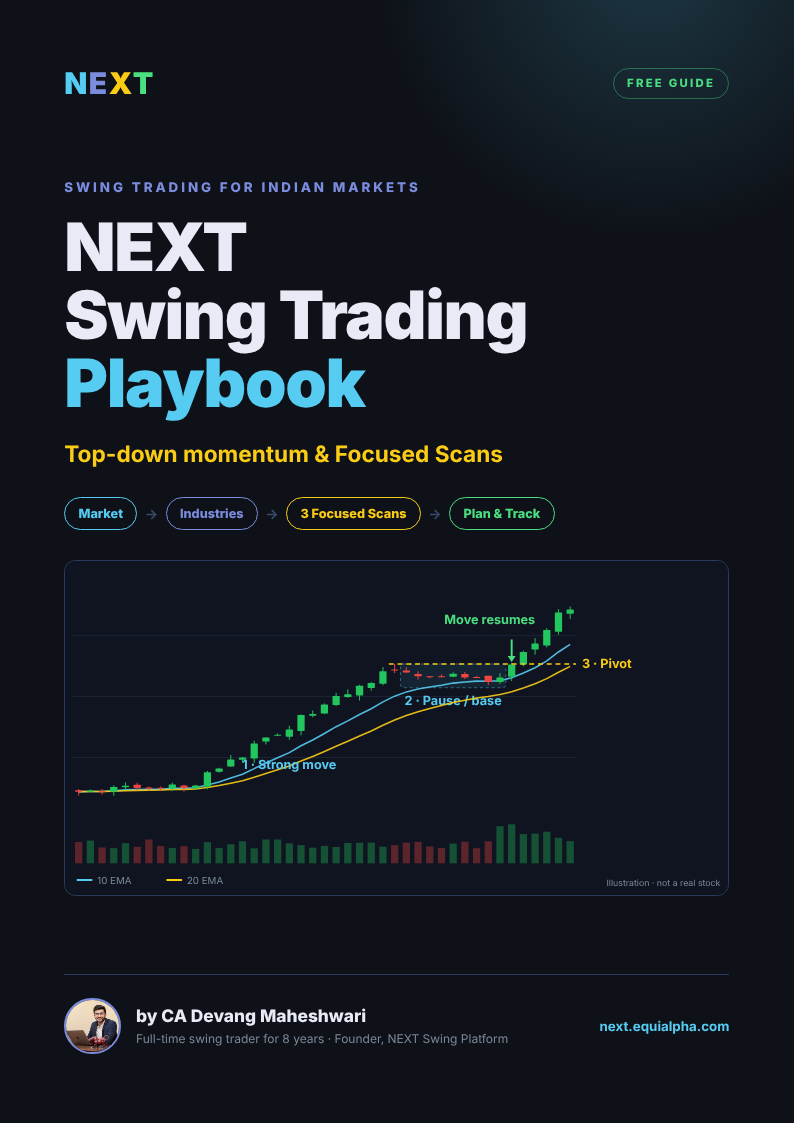
The free NEXT Swing Trading Playbook — 11 chapters, charts and printable checklists.

Written by CA Devang Maheshwari — full-time swing trader for 8 years, founder of Equialpha and builder of N.E.X.T, the swing trading platform for Indian markets. About Devang