How do I know if a stock is extended?
Look at how far price is above the pivot and above the 10 and 20 EMAs. If your logical stop would be far below the current price, the stock is extended for a new entry.
Swing trading glossary
An extended stock has run far above its pivot or its moving averages, so buying it now usually means chasing.
A stock is called extended when price has moved a long way from a sensible entry point, such as its pivot or its 10 and 20 EMAs. The move may still be strong, but the easy, low-risk entry has already passed.
Buying an extended stock creates a risk problem. The logical stop-loss is still down near the base or the averages, which is now far below the current price. Either you take a much bigger loss if the trade fails, or you place a tight stop that ordinary pullbacks will hit.
Extended stocks often pause or pull back to let the averages catch up. For a swing trader, that pullback or a new base can offer a better, lower-risk entry later. Patience usually pays more than chasing.
Being extended is not a reason to sell a position you already hold. It simply means a new entry here has poor reward compared with the risk. A simple habit helps: before entering, measure the distance from price to your stop. If that distance is much bigger than in your usual trades, the stock is probably extended for you, and waiting for a pause or a new base is the calmer choice.
A stock breaks out above ₹500 and runs to ₹590 in six sessions, while its 10 EMA is at ₹540. At ₹590 it is extended: a stop below the base near ₹480 would mean risking about ₹110 per share.
Look at how far price is above the pivot and above the 10 and 20 EMAs. If your logical stop would be far below the current price, the stock is extended for a new entry.
Yes, strong stocks can stay extended for a while. The issue is not direction but risk: a new entry far from support has a poor risk-reward.
Related terms
N.E.X.T reads the market, ranks 65+ industries and runs focused momentum scans across 2,100+ NSE stocks every day.
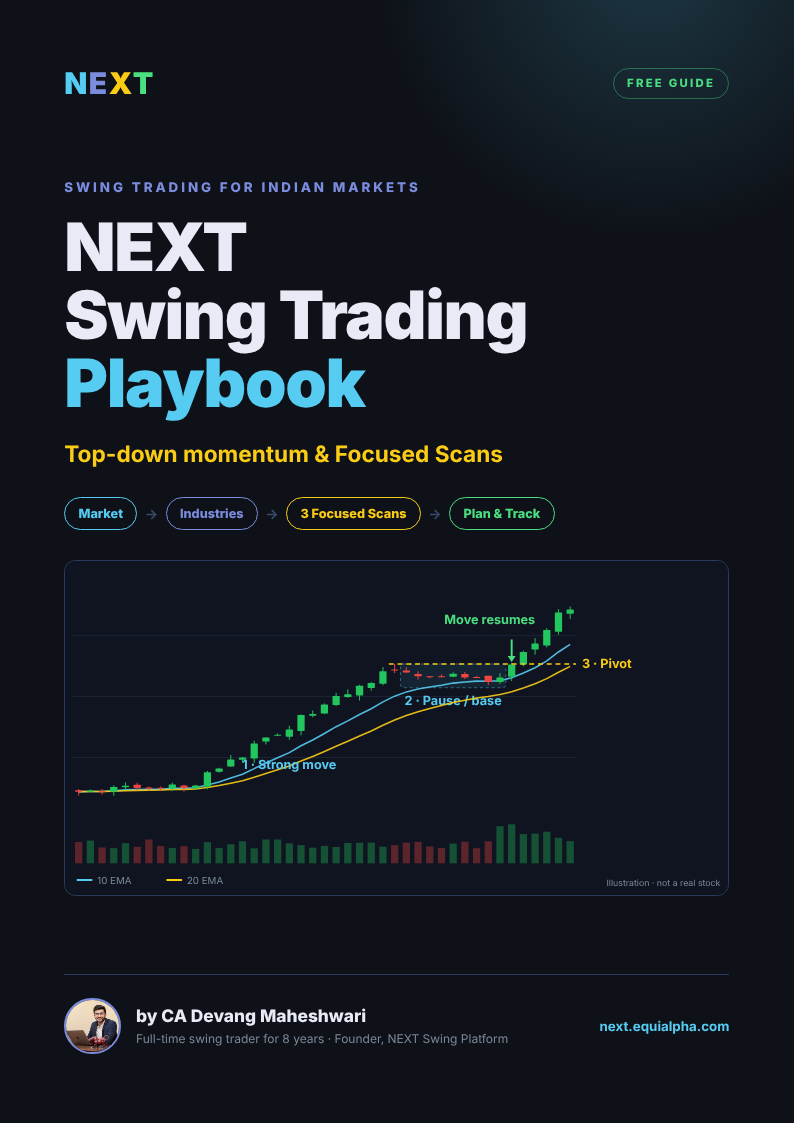
Get every guide in one PDF
The free NEXT Swing Trading Playbook — 11 chapters, charts and printable checklists.

Written by CA Devang Maheshwari — full-time swing trader for 8 years, founder of Equialpha and builder of N.E.X.T, the swing trading platform for Indian markets. About Devang