How do I calculate expectancy in trading?
Multiply your win rate by your average win, subtract your loss rate multiplied by your average loss. Measuring wins and losses in R keeps it simple.
Swing trading glossary
Expectancy is the average amount a trading method makes or loses per trade, combining win rate with average win and loss.
Expectancy answers one question: on average, what does each trade earn you? It combines how often you win with how much you win and lose. The usual formula is (win rate × average win) minus (loss rate × average loss).
Measuring it in R makes it easy to compare. If you win 40% of trades with an average of 3R and lose 60% with an average of 1R, expectancy is 0.4 × 3 minus 0.6 × 1, which is +0.6R per trade. Over many trades, that edge adds up.
Positive expectancy is the real goal of a method, more than a high win rate or a few big winners. It only shows up over a decent number of trades, so a short losing streak does not prove a method is broken, and a lucky streak does not prove it works.
Your trading journal is where expectancy comes from. Tracking R for every trade lets you see expectancy per setup and per market condition, and focus on what actually pays. Costs belong in the calculation too. Brokerage, taxes and slippage reduce every trade, so a method with a thin edge on paper can turn flat in real life. Using actual fills from your journal gives a more honest expectancy figure.
You take 20 trades. 8 win with an average of ₹6,000 and 12 lose with an average of ₹2,000. Expectancy is (8 × 6,000 − 12 × 2,000) ÷ 20 = ₹1,200 per trade.
Multiply your win rate by your average win, subtract your loss rate multiplied by your average loss. Measuring wins and losses in R keeps it simple.
Yes. Expectancy includes win rate and also the size of wins and losses, so it tells you whether the method makes money overall.
Related terms
N.E.X.T reads the market, ranks 65+ industries and runs focused momentum scans across 2,100+ NSE stocks every day.
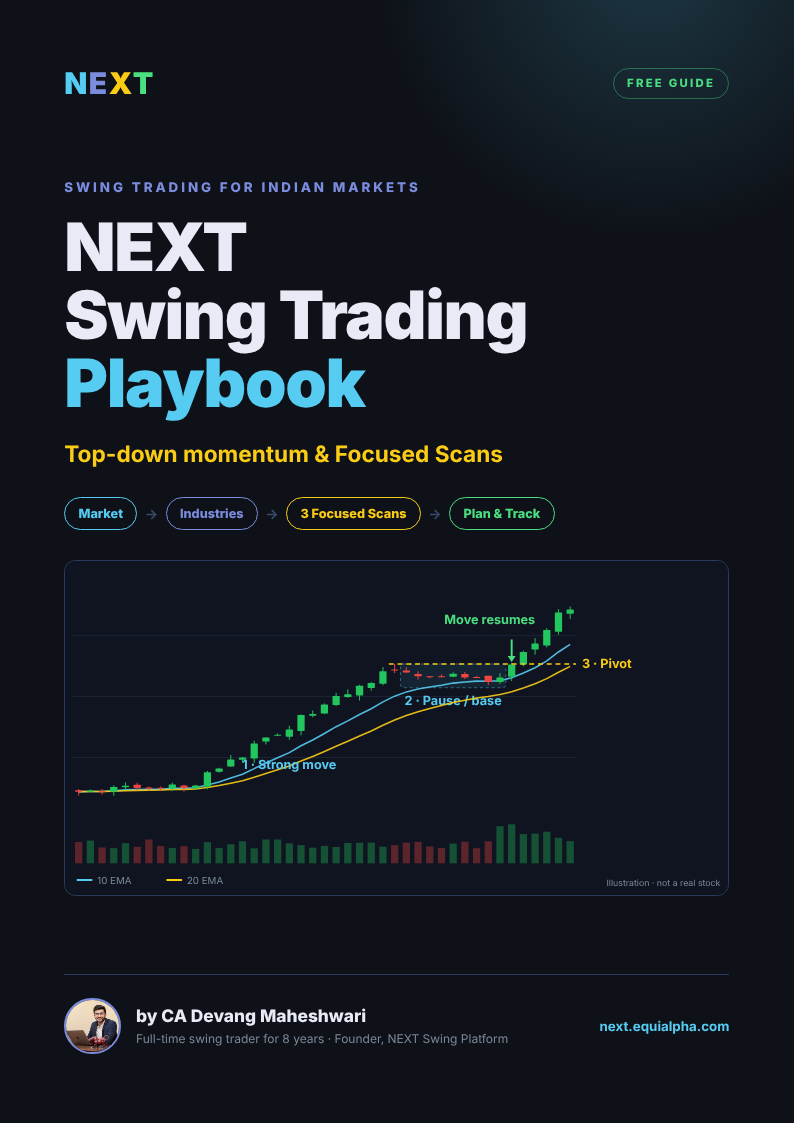
Get every guide in one PDF
The free NEXT Swing Trading Playbook — 11 chapters, charts and printable checklists.

Written by CA Devang Maheshwari — full-time swing trader for 8 years, founder of Equialpha and builder of N.E.X.T, the swing trading platform for Indian markets. About Devang