What does 2R mean in trading?
It means the trade made twice the amount you originally planned to risk. If your risk was ₹2,000, a 2R winner made ₹4,000.
Swing trading glossary
R is the amount you planned to risk on a trade; results are measured in R, so a +2R winner made twice the planned risk.
R stands for the rupee amount you decided to risk on a trade before entering. If you buy at ₹500 with a stop at ₹480 and 100 shares, your risk is ₹20 × 100 = ₹2,000. That ₹2,000 is 1R.
Measuring trades in R makes them comparable. A ₹6,000 profit on that trade is +3R. A ₹2,000 loss is −1R. It does not matter whether the stock was priced at ₹50 or ₹5,000; R tells you how well the trade did relative to the risk you took.
Thinking in R changes how you see results. You don't need to win most trades. If your losses stay near −1R and your winners average +2R or +3R, a win rate below 50% can still grow capital. The key is keeping losses small and not cutting winners too early.
R also helps with discipline. A loss of −1R is simply the planned cost of a trade. A loss of −3R means something went wrong, such as moving the stop or ignoring it. Recording every trade in R inside a trading journal also shows patterns over time, such as which setups produce the biggest winners and where losses tend to grow beyond plan.
You risk ₹5,000 per trade (1R). Over ten trades you have four winners of +3R (₹60,000) and six losers of −1R (₹30,000). Net result: +6R, or ₹30,000, with only 40% winners.
It means the trade made twice the amount you originally planned to risk. If your risk was ₹2,000, a 2R winner made ₹4,000.
They are related. Risk-reward compares the planned target with the planned risk before a trade; R measures the actual outcome against the planned risk.
Related terms
N.E.X.T reads the market, ranks 65+ industries and runs focused momentum scans across 2,100+ NSE stocks every day.
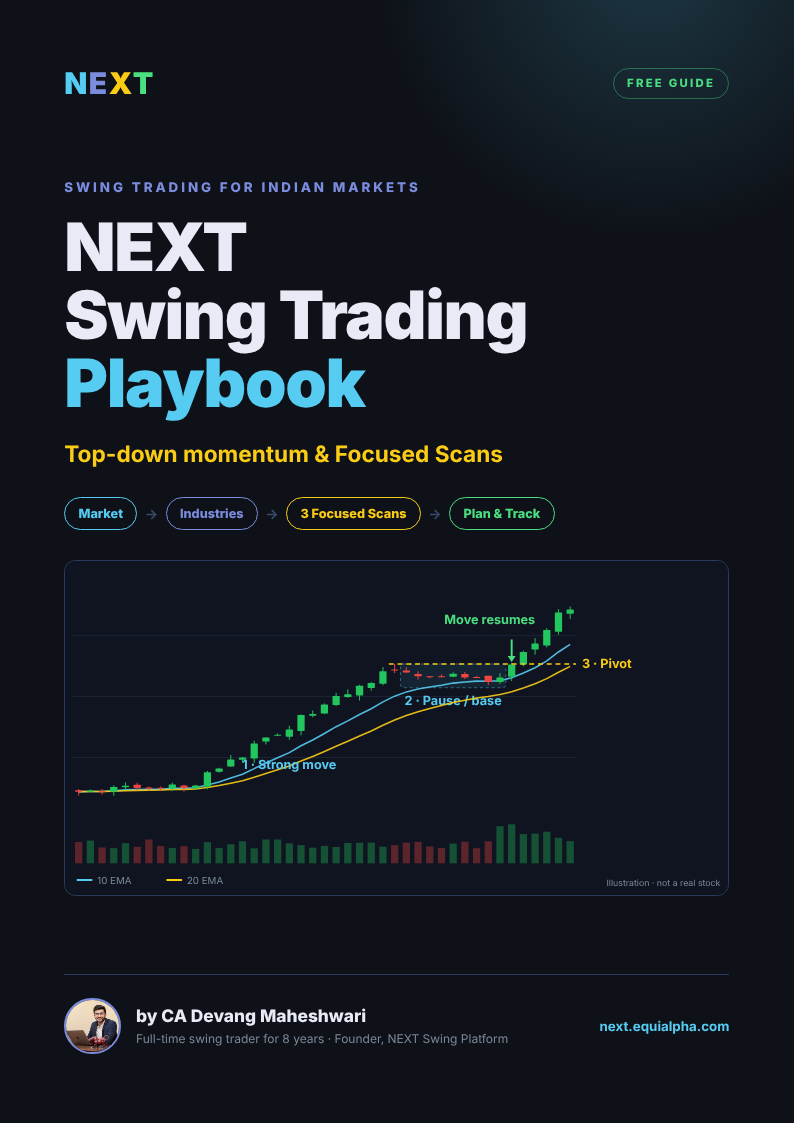
Get every guide in one PDF
The free NEXT Swing Trading Playbook — 11 chapters, charts and printable checklists.

Written by CA Devang Maheshwari — full-time swing trader for 8 years, founder of Equialpha and builder of N.E.X.T, the swing trading platform for Indian markets. About Devang