What is an acceptable drawdown for a swing trader?
It depends on the person and the method, but many traders set a limit after which they cut size or pause. Keeping risk per trade small keeps drawdowns manageable.
Swing trading glossary
Drawdown is how far your trading capital falls from its last peak before it makes a new high.
Drawdown measures the drop in your account from its highest point to the lowest point that follows. If capital grows to ₹10 lakh and then falls to ₹8.5 lakh, you are in a 15% drawdown until the account climbs back above ₹10 lakh.
Every method has drawdowns, because losing streaks are normal. What matters is how deep they get. Recovery is harder than the fall: a 20% drawdown needs a 25% gain to get back to the peak, and a 50% drawdown needs 100%.
Swing traders control drawdown mainly through position sizing and risk per trade. Risking a small, fixed slice of capital on each trade means even a long run of stop-outs takes a manageable bite. Reading the market first also helps, because many losing streaks come from forcing trades in a weak market.
Tracking drawdown in your trading journal shows whether your rules are working. A drawdown much deeper than your plan expected is a reason to cut size, trade less, and review recent trades. It also helps to decide in advance what you will do at certain drawdown levels, such as halving position size after a set fall. A rule made calmly beforehand is far easier to follow than one invented in the middle of a losing streak.
Your capital rises from ₹5,00,000 to ₹6,00,000, then a losing streak brings it to ₹5,10,000. The drawdown is ₹90,000, or 15% of the ₹6,00,000 peak.
It depends on the person and the method, but many traders set a limit after which they cut size or pause. Keeping risk per trade small keeps drawdowns manageable.
Risk a small fixed portion per trade, size every position from its stop, and trade less when the market is in a downtrend.
Related terms
N.E.X.T reads the market, ranks 65+ industries and runs focused momentum scans across 2,100+ NSE stocks every day.
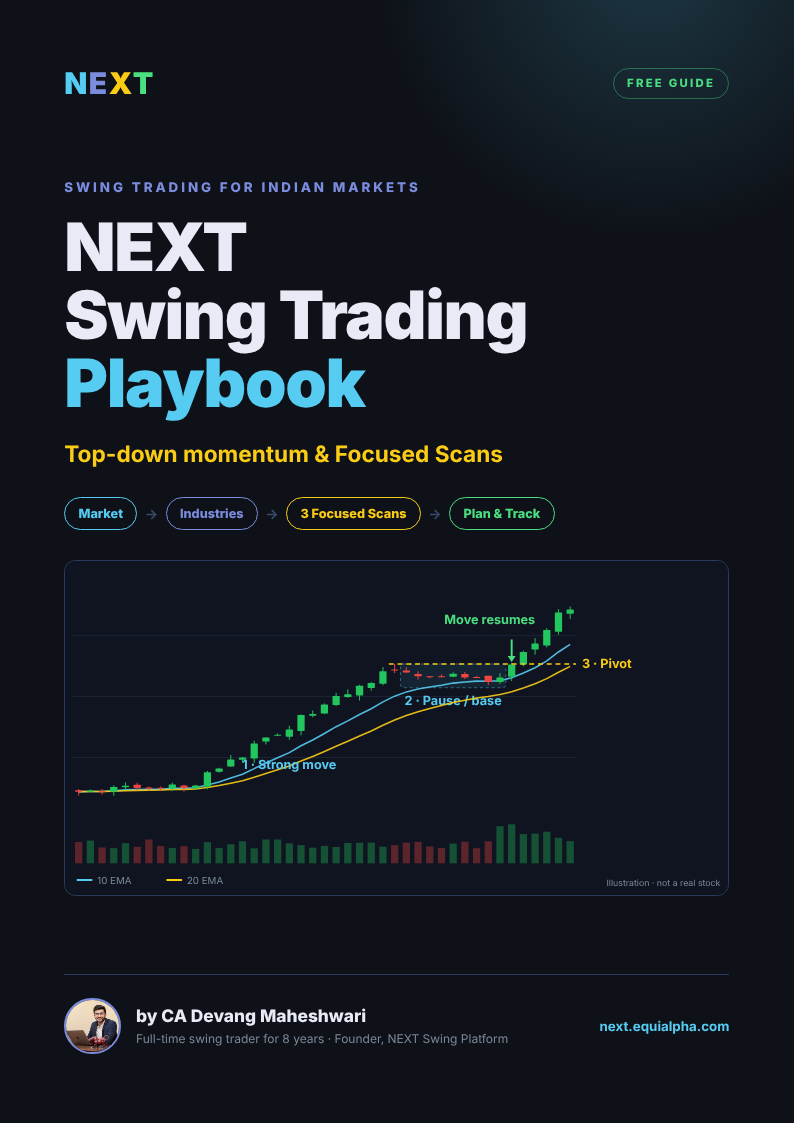
Get every guide in one PDF
The free NEXT Swing Trading Playbook — 11 chapters, charts and printable checklists.

Written by CA Devang Maheshwari — full-time swing trader for 8 years, founder of Equialpha and builder of N.E.X.T, the swing trading platform for Indian markets. About Devang