What is a good risk-reward ratio for swing trading?
Many swing traders look for trades where the realistic reward is at least two to three times the risk. The exact number matters less than keeping losses small and consistent.
Swing trading glossary
Risk-reward ratio compares how much you could lose to your stop with how much you aim to make if the trade works.
Risk-reward ratio puts two numbers side by side: the distance from your entry to your stop-loss (the risk) and the distance from your entry to a realistic target (the reward). If you risk ₹10 a share to aim for ₹30, that is 1:3.
Swing traders care about it because it decides how often you need to be right. With losses kept near 1R and winners reaching 2R or 3R, you can still grow capital while being wrong on more than half your trades.
The risk side is the part you control. You choose the stop before entry, based on where the idea is clearly wrong on the chart, such as below the base low or a key moving average. The reward side is an estimate, not a promise, so it is best treated as a rough guide.
A sensible habit is to skip trades where the stop has to be so wide that the realistic upside barely covers it. Good setups usually offer a tight, logical stop close to the entry, which naturally improves the ratio. The same entry can have a good or a poor ratio depending only on where the stop sits.
You enter at ₹200 with a stop at ₹190, so the risk is ₹10 per share. If a realistic target is ₹230, the reward is ₹30 per share. The risk-reward ratio is 1:3.
Many swing traders look for trades where the realistic reward is at least two to three times the risk. The exact number matters less than keeping losses small and consistent.
No. Win rate is how often you win. Risk-reward is how big wins are compared with losses. You need both to judge a trading method.
Related terms
N.E.X.T reads the market, ranks 65+ industries and runs focused momentum scans across 2,100+ NSE stocks every day.
Get every guide in one PDF
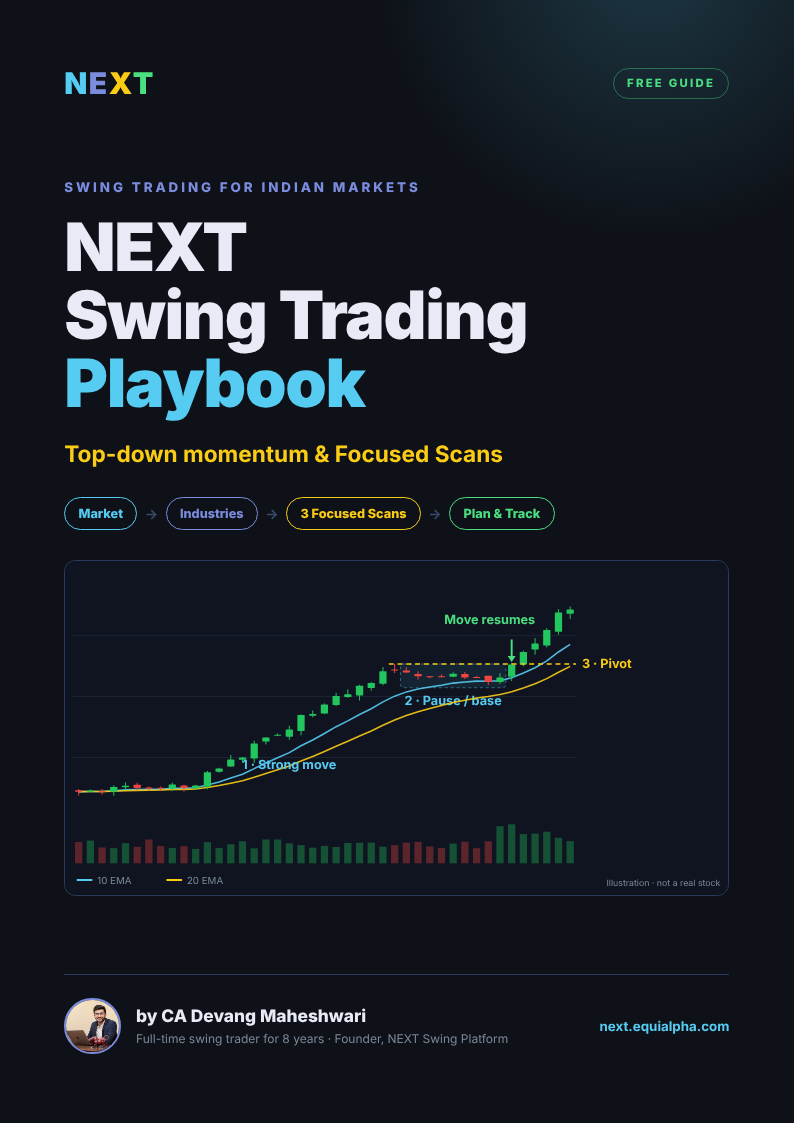
The free NEXT Swing Trading Playbook — 11 chapters, charts and printable checklists.

Written by CA Devang Maheshwari — full-time swing trader for 8 years, founder of Equialpha and builder of N.E.X.T, the swing trading platform for Indian markets. About Devang