How much should I risk per trade?
Many swing traders risk a small fixed percentage of capital per trade, often around 0.5% to 1%. The right number depends on your capital and comfort, but it should keep any single loss small.
Swing trading glossary
Position size is how many shares you buy, set from your stop-loss distance and the amount you are willing to risk on the trade.
Position size answers one question: how many shares should I buy? The answer should not come from how much money is in the account or how confident you feel. It should come from your risk.
The simple formula is: quantity = risk per trade ÷ (entry price − stop-loss price). First decide how much of your capital you will risk on one trade, often a small percentage. Then measure how far your stop is from your entry. Dividing one by the other gives the number of shares.
This keeps every trade's loss roughly the same in rupees. If the stop needs to be wider, you buy fewer shares. If the stop is tighter, you can buy more. The rupee risk stays in your control either way.
Good position sizing is what lets a trader survive a string of losses. No single trade can do serious damage to the account, so you stay in the game long enough for the winners to matter. A position size calculator makes this quick: enter your capital, risk percentage, entry and stop, and it shows the share count. Doing this for every trade, even small ones, builds the habit that protects the account when a run of losses comes.
Capital is ₹5,00,000 and you risk 1% per trade, which is ₹5,000. Entry is ₹412 and the stop is ₹392, a ₹20 risk per share. Quantity = ₹5,000 ÷ ₹20 = 250 shares.
Many swing traders risk a small fixed percentage of capital per trade, often around 0.5% to 1%. The right number depends on your capital and comfort, but it should keep any single loss small.
Not if you size correctly. A wider stop means fewer shares, so the rupee risk stays the same.
Related terms
N.E.X.T reads the market, ranks 65+ industries and runs focused momentum scans across 2,100+ NSE stocks every day.
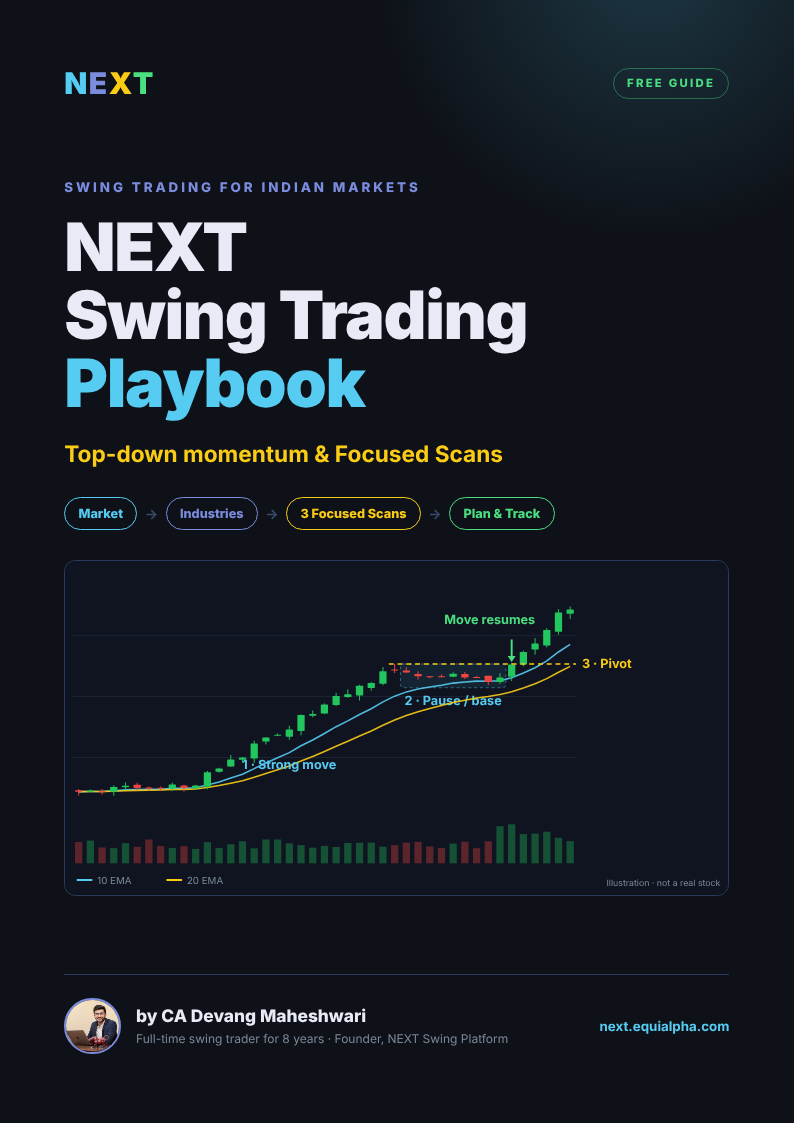
Get every guide in one PDF
The free NEXT Swing Trading Playbook — 11 chapters, charts and printable checklists.

Written by CA Devang Maheshwari — full-time swing trader for 8 years, founder of Equialpha and builder of N.E.X.T, the swing trading platform for Indian markets. About Devang