What is the difference between SMA and EMA?
An SMA weights every day equally; an EMA gives more weight to recent days, so it reacts faster to new price moves.
Swing trading glossary
A moving average is the average closing price over a set number of sessions, recalculated each day to smooth out noise.
A moving average takes the closing prices of the last set number of sessions and averages them, updating every day. Plotted on a chart, it becomes a smooth line that follows price and filters out day-to-day noise.
There are two common types. A simple moving average (SMA) gives every day equal weight. An exponential moving average (EMA) gives more weight to recent days, so it reacts faster. Swing traders often use EMAs for short periods, such as the 10 and 20 EMA, and slower averages like the 50 EMA or 200 DMA for the bigger trend.
Moving averages help in three ways: they show the direction of the trend, they act as dynamic support in strong uptrends, and they help judge whether a stock is extended. A stock far above its 10 or 20 EMA has run hard and may need to rest.
They are lagging tools. They describe what price has done, not what it will do, so they work best combined with price structure, volume and a defined stop-loss. Two or three averages are usually enough; more lines add clutter, not clarity.
A 5-day simple moving average of closes at ₹100, ₹102, ₹104, ₹103 and ₹106 is ₹103. The next day, if the stock closes at ₹108, the oldest ₹100 drops out and the average rises to ₹104.60.
An SMA weights every day equally; an EMA gives more weight to recent days, so it reacts faster to new price moves.
Commonly the 10 and 20 EMA for short-term strength, and the 50 EMA or 200 DMA for the larger trend.
Related terms
N.E.X.T reads the market, ranks 65+ industries and runs focused momentum scans across 2,100+ NSE stocks every day.
Get every guide in one PDF
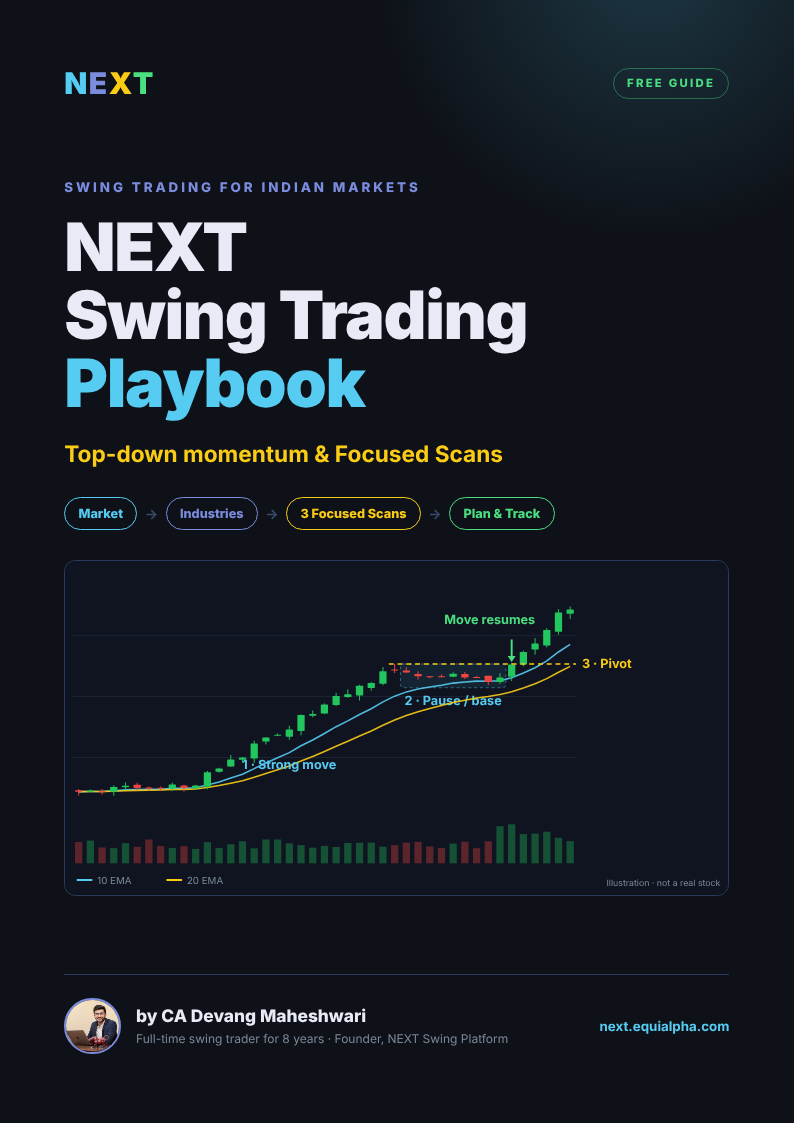
The free NEXT Swing Trading Playbook — 11 chapters, charts and printable checklists.

Written by CA Devang Maheshwari — full-time swing trader for 8 years, founder of Equialpha and builder of N.E.X.T, the swing trading platform for Indian markets. About Devang