How long do swing traders hold a stock?
Usually from about a week to a couple of months. The holding period depends on how long the move keeps its strength, not on a fixed number of days.
Swing trading glossary
Swing trading means holding a stock for a few days to a few weeks to capture one meaningful leg of a price move.
Swing trading sits between intraday trading and long-term investing. A swing trader buys a stock as it starts a new leg up and holds it for roughly a week to a couple of months, then exits when the move tires or the stop-loss is hit. The aim is not to catch the whole trend, only one clean swing of it.
Most swing traders work from daily charts. They review the market after the 3:30 PM close, look for strong stocks in strong industries that are pausing in a base, and plan an entry above a pivot with a stop-loss decided in advance. Orders are placed for the next session, so there is no need to watch the screen all day.
What makes swing trading workable is risk control. Each trade has a defined stop, the position size is set from that stop, and losses are kept small so that a few good swings can more than cover them. Process matters more than any single trade.
Swing trading suits people with a job or business because the routine is short and done in the evening. It still needs patience: on many days the right action is to wait.
Say you have ₹5,00,000 of capital and risk 1% per trade (₹5,000). A stock breaks out of a base at ₹400 with a stop at ₹380, so the risk per share is ₹20 and you buy 250 shares. If the swing carries it to ₹460 over three weeks, you book ₹15,000, or 3R.
Usually from about a week to a couple of months. The holding period depends on how long the move keeps its strength, not on a fixed number of days.
Neither is better for everyone. Swing trading needs less screen time and uses daily charts, which suits people who can only review the market in the evening.
Related terms
N.E.X.T reads the market, ranks 65+ industries and runs focused momentum scans across 2,100+ NSE stocks every day.
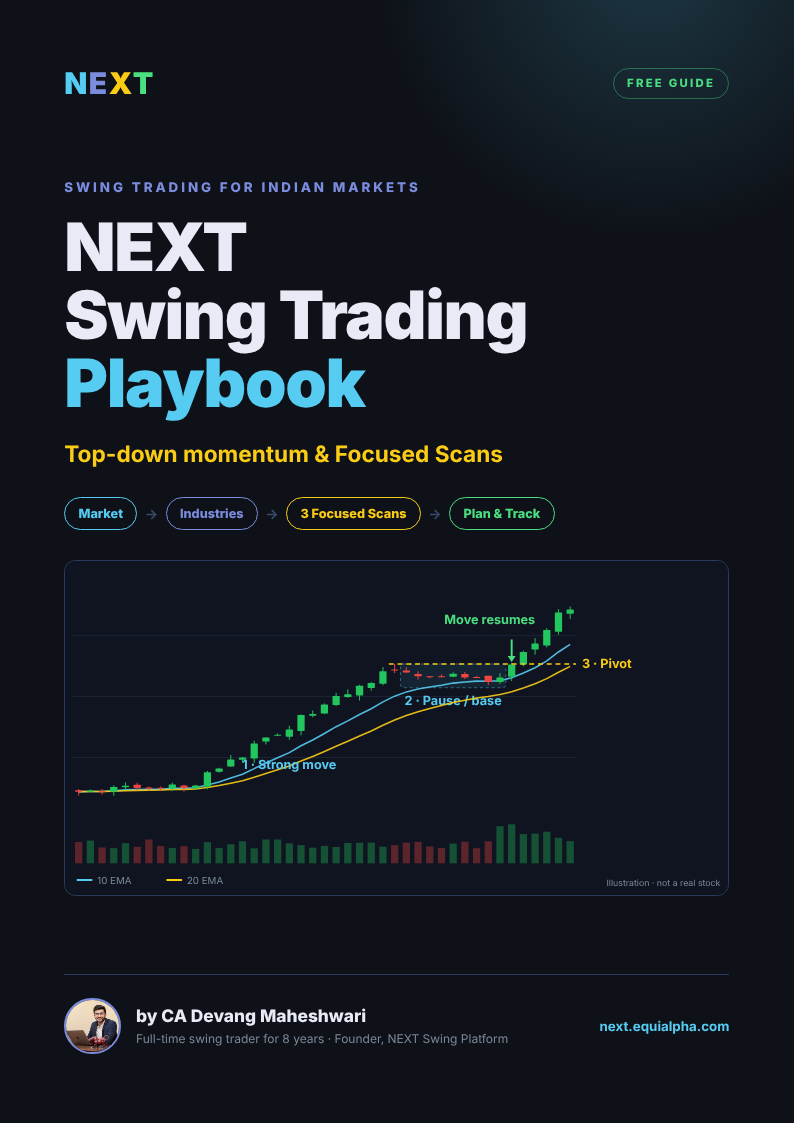
Get every guide in one PDF
The free NEXT Swing Trading Playbook — 11 chapters, charts and printable checklists.

Written by CA Devang Maheshwari — full-time swing trader for 8 years, founder of Equialpha and builder of N.E.X.T, the swing trading platform for Indian markets. About Devang