What is the difference between swing and positional trading?
Swing trading targets one leg of a move over days to weeks, while positional trading tries to hold the larger trend for months. Positional trades use wider stops and slower averages.
Swing trading glossary
Positional trading means holding a stock for several months to ride a larger trend, with wider stops than a swing trade.
Positional trading is a longer cousin of swing trading. Instead of capturing one leg of a move, a positional trader tries to stay in a stock for the bigger trend, often several months, as long as the trend structure stays intact.
Because the holding period is longer, positional trades usually use weekly charts or slower averages such as the 50 EMA or the 200 DMA to judge the trend. Stops are wider, so position sizes are smaller for the same rupee risk. The trader accepts deeper pullbacks along the way in exchange for the chance of a larger move.
Swing trading and positional trading can share the same stock selection: strong stocks, in strong industries, in a healthy market. The difference is mainly in exits. A swing trader books the move when it tires; a positional trader holds until the trend itself breaks.
Many traders combine both, booking part of a position on the swing and holding the rest positionally with a trailing stop-loss. Whichever style you pick, decide it before entry so the stop, the size and the exit plan all match the holding period.
You buy 100 shares at ₹1,000 with a positional stop below the 50 EMA at ₹880, a risk of ₹120 per share or ₹12,000. Over five months the stock trends to ₹1,500 and you exit when it closes below the 50 EMA at ₹1,420, booking ₹42,000.
Swing trading targets one leg of a move over days to weeks, while positional trading tries to hold the larger trend for months. Positional trades use wider stops and slower averages.
Mostly daily and weekly charts, with slower moving averages like the 50 EMA or 200 DMA to judge whether the trend is still intact.
Related terms
N.E.X.T reads the market, ranks 65+ industries and runs focused momentum scans across 2,100+ NSE stocks every day.
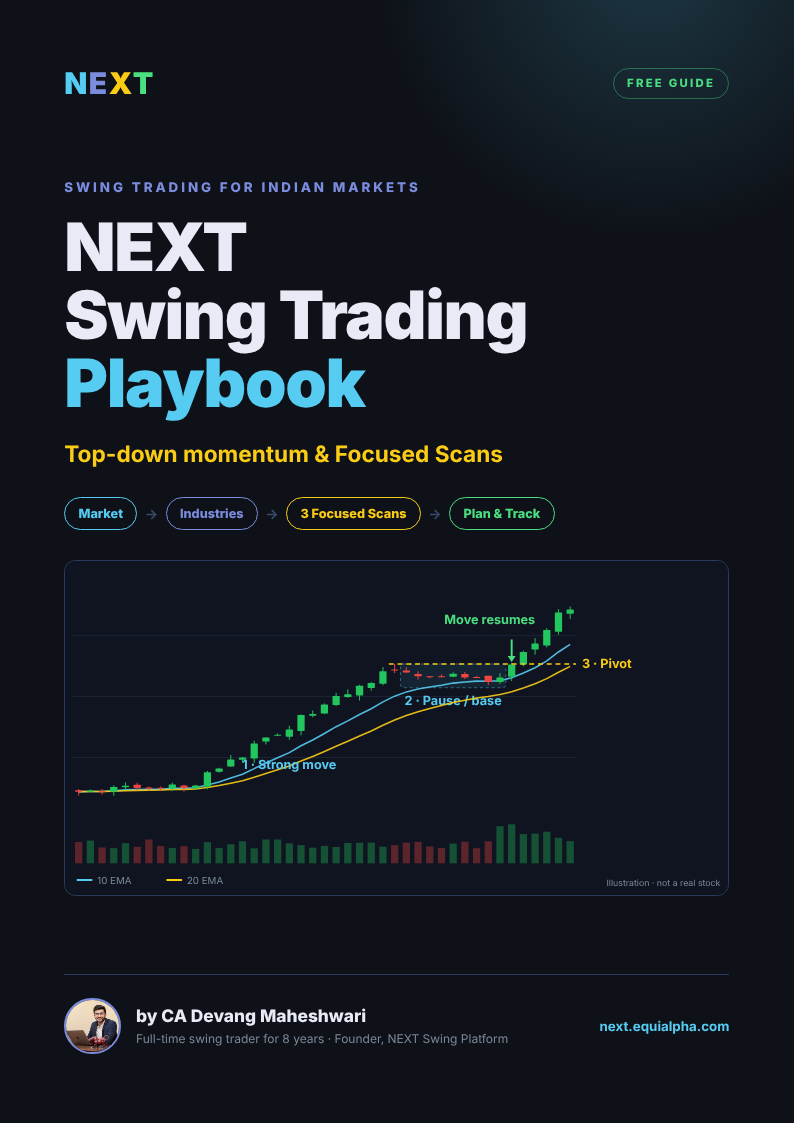
Get every guide in one PDF
The free NEXT Swing Trading Playbook — 11 chapters, charts and printable checklists.

Written by CA Devang Maheshwari — full-time swing trader for 8 years, founder of Equialpha and builder of N.E.X.T, the swing trading platform for Indian markets. About Devang