Start here

Swing Trading vs Positional Trading: Which Suits You?

Both hold stocks for more than a day. The difference is how long you stay in, how much of the move you aim for, and how you manage the trade.

By CA Devang Maheshwari · Updated 2 November 2026

Quick answer

Swing trading rides one leg of a move — roughly 8–10 sessions to about 2 months — using daily charts, defined setups and tighter stops. Positional trading holds for several months, aiming for the larger trend, with wider stops and less frequent decisions. Swing trading needs a short daily review; positional trading needs more patience and room for bigger pullbacks.

From shortest to longest

Step 1
Intraday

Minutes to hours

Step 2
Swing

≈ 8–10 sessions to 2 months

Step 3
Positional

Several months

Step 4
Investing

Years

The differences side by side

Swing tradingPositional trading
Holding periodAbout 8–10 sessions to 2 monthsSeveral months, sometimes longer
GoalOne meaningful leg of a moveA large part of the trend
Main chartDaily candlesDaily and weekly
EntriesDefined setups at a pivotBases and pullbacks within a long trend
Stop-lossTighter (below the base or a fixed %)Wider, to sit through normal pullbacks
DecisionsFrequent, short daily reviewFewer, more patience
Turnover of capitalHigher — more tradesLower — fewer trades

Holding period is guided by price action and market conditions, not a fixed calendar.

Which one suits you?

Swing trading suits you if…

You can spend 15–60 minutes after the close, like clear rules and defined risk, and want capital to move between ideas.

Positional trading suits you if…

You'd rather check less often, can sit through 10–20% pullbacks, and want to hold strong trends for months.

Many traders do both: they take swing trades from defined setups and let the strongest winners run as positional holds, trailing the stop under a rising average.

What both have in common

  • Market direction first — both work far better in an uptrend. See the top-down approach.
  • Strong stocks in strong industries — momentum matters for both.
  • A stop-loss and position sizing on every trade — see stop-loss in swing trading.
  • A journal — so you know which style actually works for you.

Tip

Not sure? Start with swing trading on daily charts: the feedback is faster, so you learn sooner what works for you.

Frequently asked questions

What is the difference between swing and positional trading?

Swing trading holds for roughly 8–10 sessions to about 2 months to capture one leg of a move with tighter stops. Positional trading holds for several months to ride a larger trend with wider stops.

Which is better for working professionals?

Both can work after market hours. Swing trading needs a short daily review after the close; positional trading needs fewer decisions but more patience through pullbacks.

Is positional trading less risky than swing trading?

Not automatically. Positional trades use wider stops and sit through bigger swings. Risk depends on position size and stop placement, not the label.

Can I convert a swing trade into a positional trade?

Many traders let their strongest winners run by trailing the stop under a rising moving average. Decide the rule in advance rather than holding a losing trade longer.

Built for swing traders

N.E.X.T follows the swing trader's evening routine: market direction, 65+ industries rated on momentum and three focused scans.

Get every guide in one PDF

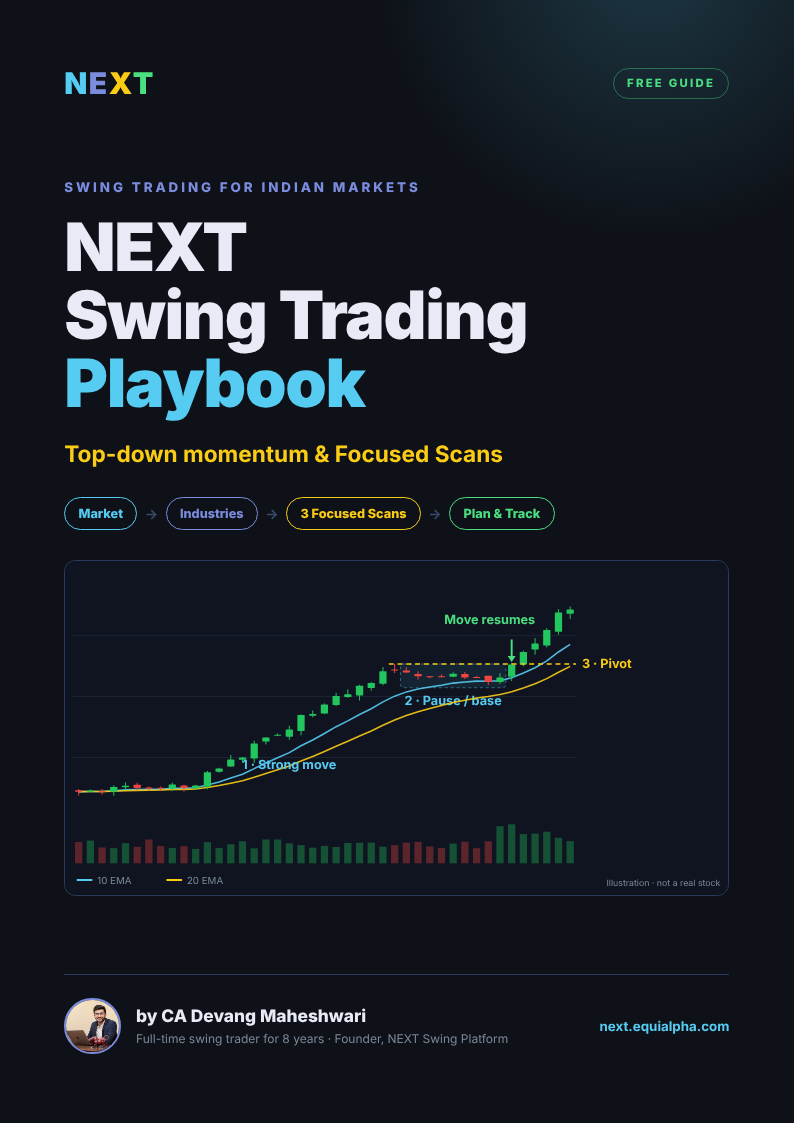
The free NEXT Swing Trading Playbook — 11 chapters, charts and printable checklists.

Keep reading

Browse all guides →
CA Devang Maheshwari

Written by CA Devang Maheshwari — full-time swing trader for 8 years, founder of Equialpha and builder of N.E.X.T, the swing trading platform for Indian markets. About Devang